
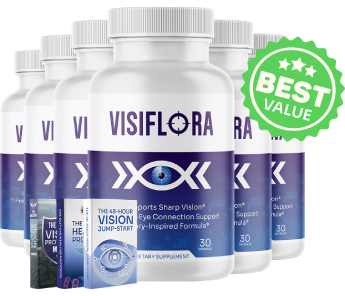
Introduction & What Is VisiFlora?
VisiFlora is a daily capsule marketed for vision support, sold on the idea that failing eyesight starts in the gut. The manufacturer states roughly 21 ingredients across four blends: a Vision Defense Matrix, a Gut-Eye Barrier Complex, Vision Performance Boosters, and a Macular and Lens Protection Blend. Among them are lutein, zeaxanthin, zinc, copper, vitamins C and E, bilberry, astaxanthin, saffron, ginkgo, quercetin and alpha lipoic acid.
This product is genuinely more interesting than most we review, and for an awkward reason: part of it has real evidence behind it. Lutein, zeaxanthin, zinc, copper, vitamin C and vitamin E are the AREDS2 formula, which the National Eye Institute tested in a large randomized trial and which is the one supplement combination in eye health that a doctor might actually recommend. Those ingredients are in this bottle.
The awkwardness is that the marketing does not sell them. It sells a story about a gut toxin eating your retina, and it explicitly positions itself against AREDS2, with one affiliate headline reading "5X More Powerful Than AREDS2?". The product contains the evidence-backed formula and its own marketing attacks the evidence-backed formula. Untangling that is what this review is for.
Below: what the AREDS2 evidence actually shows and for whom, whether the gut toxin story holds, what the vendor's own affiliate materials say, the pricing, and the one claim on this page that we consider genuinely dangerous. Disclosure, as on every page of this site: we are independent reviewers, and purchases through our links may earn us a commission at no additional cost to you.
How Does It Work?
The marketed mechanism is LPS, or lipopolysaccharide, described as a gut toxin that travels to the eyes and eats the retina "like rust". Flushing it out, the story goes, restores vision.
The starting point is real, and it is worth being fair about. LPS is a genuine bacterial endotoxin, found in the outer membrane of gram-negative bacteria. It is a legitimate and heavily used research tool in inflammation science. The gut-eye axis is a real emerging field, and there is published work exploring associations between intestinal permeability, systemic inflammation and eye conditions including uveitis and macular degeneration. A reader who looks up "LPS retina" will find scientific papers, which is exactly why this hook works.
What the research does not contain is the rest of the sales page. There is no evidence that LPS causes floaters, which are almost always benign changes in the vitreous gel. There is no evidence that LPS causes night vision difficulty, which usually reflects lens changes, pupil size or retinal function. There is no evidence that any supplement removes LPS from the eye, and no trial has tested that proposition. Emerging associations in inflammation research have been converted into a settled cause with a product attached, which is the same move we see across this category.
The "12-second eye detox ritual" and the "94% success rate" correspond to nothing. There is no such protocol in the literature and no study producing that figure.
Meanwhile the actual mechanism worth discussing is sitting unadvertised in the same bottle. Lutein and zeaxanthin are carotenoids that concentrate in the macula and form macular pigment, which absorbs blue light and acts as an antioxidant. That is real physiology, it is why AREDS2 tested them, and it is the part of this product a doctor would recognize. The marketing walked past it to sell rust.
The AREDS2 Question, Which Is the Real One
AREDS2 is the reason this category exists at all, and it is routinely misrepresented, including here. What it actually found is specific and worth stating precisely.
The National Eye Institute ran two large randomized trials. They tested a combination of antioxidants and zinc in people who already had age-related macular degeneration. The finding: in participants with intermediate AMD, or advanced AMD in one eye, the formula reduced the risk of progressing to advanced AMD by roughly a quarter over five years. AREDS2 refined the formula, replacing beta-carotene, which had raised lung cancer risk in smokers, with lutein and zeaxanthin.
That is a real result from a real trial, and it is why eye doctors do recommend AREDS2 formulations to a specific group of patients.
Now the parts the marketing omits:
| What AREDS2 showed | What it did not show |
|---|---|
| Slowed progression in people with intermediate AMD or advanced AMD in one eye | Did not prevent AMD in people with healthy eyes or early AMD |
| Roughly 25% reduction in progression risk over 5 years | Did not restore or improve vision that was already lost |
| Benefit measured against a defined clinical endpoint | Did nothing for floaters, night vision, eye strain or "yellow gunk" |
| Used specific, disclosed, high doses | Says nothing about products with undisclosed doses |
So the honest position on VisiFlora's most credible ingredients is narrow. If a reader has been diagnosed with intermediate AMD, an AREDS2 formulation has genuine evidence, and their ophthalmologist will say so and can name a formulation at the tested doses. If they have healthy eyes and want to prevent AMD, AREDS2 did not show that. If they want their floaters gone or their night driving improved, AREDS2 has nothing to say and neither does this bottle.
And because VisiFlora's doses are not disclosed, the one thing that would make its AREDS2 ingredients meaningful, matching the tested amounts, cannot be verified before buying. AREDS2 was not a list of ingredients. It was a list of ingredients at specific doses, and that distinction is the entire finding.
Core Ingredients Analysis
| Ingredient | What it is included for | Evidence snapshot |
|---|---|---|
| Lutein & zeaxanthin | Macular pigment. | The strongest inclusions. AREDS2 tested them at 10mg and 2mg for AMD progression. Dose here undisclosed. |
| Zinc & copper | AREDS2 components. | Real evidence in the AREDS2 population. AREDS2 used 80mg zinc with 2mg copper, since high zinc depletes copper. Including copper is a sensible sign. |
| Vitamins C & E | AREDS2 antioxidants. | Part of the tested formula. High-dose vitamin E has its own safety literature; see below. |
| Saffron extract | Emerging AMD ingredient. | The most interesting non-AREDS2 inclusion. Small preliminary trials in AMD, not replicated at scale. |
| Astaxanthin, bilberry, lycopene | Antioxidants for eye health. | Popular; human outcome evidence is preliminary. Bilberry's night vision reputation traces to wartime folklore rather than trials. |
| Ginkgo, coleus forskohlii, eyebright | "Vision performance". | No established vision outcome evidence. Ginkgo has real bleeding interactions; coleus can lower blood pressure. |
| Quercetin, rutin, taurine, alpha lipoic acid, grape seed | The "Gut-Eye Barrier Complex". | Carry the LPS story. No evidence any of them affects LPS in the eye or vision outcomes. |
The picture that emerges is a product with a genuinely reasonable core and a story bolted to the side. Whoever formulated this knew what AREDS2 was, included its components, and remembered the copper. That is more competence than most of this shelf shows. Whoever marketed it decided that "contains the formula your eye doctor might recommend, if you have intermediate AMD" does not sell, and reached for rust and fighter pilots instead.
The arithmetic problem is familiar. AREDS2's zinc alone is 80mg, and its vitamin C is 500mg. Those are large amounts. Fitting them alongside 15 other ingredients in a daily capsule is possible only if the capsule is large or the other ingredients are token. Since no doses are published, a buyer cannot know which.
Safety notes that matter here. High-dose zinc can cause stomach upset and copper deficiency, which is why the copper matters. High-dose vitamin E has been associated with increased prostate cancer risk in the SELECT trial, which is a real consideration for older men taking it long term. Ginkgo has antiplatelet activity and interacts with anticoagulants and with surgery. Coleus forskohlii can lower blood pressure and may interact with blood pressure medication. Anyone on medication, and anyone already taking an AREDS2 product from their doctor, should not add this without asking first, because doubling up on zinc and vitamin E is a real way to get too much of both.
What the Vendor's Own Materials Say
The affiliate resources page for this product is unusually candid, and it is public. It describes the opportunity to affiliates in these terms: "88M+ boomers are panicking about going blind, and almost NOBODY is running vision with the gut angle. Floaters, night blindness, yellow discharge = pain points with zero ad fatigue." It closes a section with "Plug it in, scale it up, cash out."
It then offers affiliates a choice of five video sales letter openings, described in the vendor's own words: a classic quiz lead, an "Emotional 'Legally Blind Lead'" for "more emotionally charged audiences", an "Emotional 'Car Crash' lead" characterized as a "powerful 'blind in 60 seconds' intro", an "Eye Toxin Footage" lead, and a "Military Discovery Lead". The company also offers custom intros including a "caregiver fear" angle.
We are not inferring the intent here. The vendor has written it down: fear of blindness is the product, and the emotional register is a configurable setting.
The email swipes the company supplies to affiliates make the following claims: a "94% success rate"; that the method is "5X more effective than anything your eye doctor prescribes"; that "95% of vision problems are NOT caused by aging, blue light, or bad genetics"; that LPS "slowly eats your retina away"; that morning eye discharge is "a 90% sign that your eyes are being poisoned"; and that a 12-second ritual can "flush out 90% of the toxic eye buildup". Suggested subject lines include "Your Eye Doctor May Be Making You Go Blind (Here's Proof)".
None of these figures corresponds to any published research. There is no 94 percent, no 95 percent, no 90 percent, no Pentagon eye doctor and no leaked footage. The morning discharge claim deserves specific correction because it is the one most likely to be acted on: a small amount of crust on waking is normal. Genuinely purulent yellow or green discharge can indicate conjunctivitis and warrants care. It is not a sign of gut toxins, and reframing an ordinary observation as evidence of poisoning is how a person is moved from calm to frightened in one email.
Real User Benefits & Drawbacks
Pros
- Contains the AREDS2 ingredients, the only supplement combination in eye health with a large positive randomized trial behind it.
- Includes copper alongside zinc, which is the correct formulation choice and indicates someone knew the AREDS2 literature.
- Saffron is a legitimate, interesting inclusion with small preliminary AMD trials.
- 60-day money-back guarantee processed through ClickBank rather than at the vendor's discretion.
- Ingredients are named and grouped, which is more transparency than several competitors offer.
Cons
- Doses are not disclosed, which is the one thing that would make the AREDS2 ingredients meaningful.
- The LPS story is early-stage research sold as a settled cause, with no evidence it affects floaters, night vision or the retina as described.
- The marketing attacks AREDS2 while the bottle contains it.
- The vendor's affiliate materials describe fear of blindness as the product and offer emotional registers as a menu option.
- "Your Eye Doctor May Be Making You Go Blind" is a supplied headline, and it is the most harmful thing on this page.
- Real interaction and overdose risk: ginkgo, high-dose zinc and vitamin E, especially for anyone already on an AREDS2 product.
- No independent trials of the finished formula.
Pricing, Packages & Refund Policy
VisiFlora is sold through the official website. Promotional pricing runs roughly $49 to $79 per bottle depending on bundle size, with free US shipping on multi-bottle orders and digital bonuses included on the larger packages. Confirm live pricing at checkout, since offers change frequently.
The figure worth knowing comes from the vendor's affiliate page rather than its sales page: VisiFlora advertises an average order value above $200 to affiliates, with 65 percent commission on front-end sales and 60 percent on upsells. Against a $49 to $79 bottle price, that means the typical order is not one bottle. The upsell sequence after checkout sets the real cost, and it is disclosed to affiliates rather than to customers.
The stated refund policy is a 60-day money-back guarantee processed through ClickBank's standard retail support. Keep the order confirmation email, since ClickBank handles refunds against the order number.
One neutral comparison: AREDS2 formulations at the tested doses are sold by ordinary supplement brands, in pharmacies, typically for a fraction of this price, with the amounts printed on the label.
How It Compares to the Alternatives
Against an AREDS2 product with printed doses: this is the direct comparison, and it is not close. If a reader has intermediate AMD and their ophthalmologist recommends an AREDS2 formulation, that formulation is available at the doses the trial used, from brands that state the amounts, at a lower price. The evidence belongs to the doses, not to the ingredient names.
Against an eye exam: the strongest argument against this product is not that it fails to work. It is that vision changes are diagnostic events. Wet AMD is treatable, and the treatment window matters enormously. A sudden increase in floaters with flashes of light can indicate a retinal tear or detachment, which is an emergency measured in hours and days. Diabetic retinopathy is found by screening before it is felt. Cataracts are fixed by surgery. Every one of those is identified by an exam and none by a capsule.
Against the free measures: for eye strain and screen fatigue, the practical steps cost nothing and are covered in our article on digital eye strain. For AMD risk specifically, not smoking, managing blood pressure and protecting eyes from sun have better support than most of what is sold.
Against other vision supplements: our review of iGenics covers another product in this category, and the pattern is consistent: a credible carotenoid core wrapped in a story that has nothing to do with it.
What the Independent Research Actually Says
The trial the marketing attacks. The National Eye Institute maintains a public summary of the AREDS and AREDS2 studies, including exactly who benefited and by how much. It is the single most useful page a person shopping this category can read, and it is worth noting that it is more measured than any sales page built on it.
What AMD is and how it is managed. The NEI's page on age-related macular degeneration covers the condition, the difference between dry and wet forms, and the treatments that exist. Wet AMD in particular is treatable, which is why delay is the thing that costs vision.
Floaters, plainly. The NEI's page on floaters explains what they are, that they are usually harmless, and, importantly, when they are not. A sudden increase in floaters with flashes is the warning sign, and no supplement addresses it.
The clinical perspective. The American Academy of Ophthalmology's patient information on macular degeneration covers the same ground from the profession that treats it, including where supplements do and do not fit.
The regulatory frame. VisiFlora is regulated as food under the FDA's dietary supplement framework: no pre-market efficacy review, no requirement to disclose blend amounts, and disease claims not permitted. That last point is worth holding against an email telling readers their eye doctor may be making them go blind.
What to Expect: A Realistic Timeline
- Night 1: The emails promise floaters lifting by morning. Nothing in this bottle has a mechanism that acts overnight, and floaters are physical structures in the vitreous gel. They do not dissolve.
- Weeks 1–8: Nothing measurable should be expected. Even in AREDS2, the ingredients did not improve vision at all; they slowed a disease process over years, in people who already had it. That is the ceiling for the credible part of this formula, and it is not a ceiling anyone feels.
- Months 3–12 and beyond: AREDS2's benefit was measured over five years against a clinical endpoint an ophthalmologist assesses. It is not something a person notices, which is precisely why this evidence cannot be self-tested and why the 60-day refund window has nothing to do with whether it is working.
The honest implication is uncomfortable for the whole category: the one part of this product with real evidence produces an effect the buyer cannot perceive, over a timescale longer than the guarantee, in a population most buyers are not in. Anything a person does notice in 60 days is not that.
Two situations override everything above. A sudden increase in floaters, flashes of light, a curtain or shadow across the vision, or sudden vision loss are emergencies. Straight lines appearing wavy is a classic sign of wet AMD, which is treatable and time-sensitive. In either case the correct action is an eye doctor today, not a capsule tonight.
Who the Evidence Applies To, and Who Should Avoid It
There is a population for whom this product's core ingredients have evidence, and it is narrow enough to state in a sentence: people diagnosed with intermediate AMD, or advanced AMD in one eye, for whom an AREDS2 formulation at the tested doses may slow progression by roughly a quarter over five years. That is a genuine finding and a worthwhile one. It also describes a person who has already seen an ophthalmologist, who has a diagnosis, and whose doctor can name a product with the doses printed on the label. That person does not need this bottle, and buying it would mean accepting undisclosed amounts of the exact ingredients whose amounts are the entire point.
Everyone else the marketing targets is outside the evidence. AREDS2 did not prevent AMD in healthy eyes. It did not restore lost vision. It did nothing for floaters, night driving, eye strain or morning crust, which are the four things the emails are built around because they are the four things people notice. The gut toxin story that connects those symptoms to the product connects nothing: LPS is real, the gut-eye axis is a real early field, and none of it establishes that a supplement clears anything from an eye.
Several groups should be specifically careful. Anyone already taking an AREDS2 product from their doctor should not add this, because zinc at 80mg and vitamin E at AREDS2 levels are not amounts to double accidentally, and the undisclosed dosing makes that impossible to calculate. Anyone on anticoagulants or facing surgery should note the ginkgo. Anyone on blood pressure medication should note the coleus forskohlii. Men taking high-dose vitamin E long term have the SELECT trial's prostate cancer signal to discuss with a doctor. And anyone with a copper or zinc issue should note that the balance here is unknown.
The people who should not buy this under any framing are the ones the "car crash" lead and the "caregiver fear" angle are written for: someone frightened about losing their sight who has not had an exam. Wet AMD is treatable and the window matters. Retinal detachment is measured in hours. Diabetic retinopathy is silent until it is not. Glaucoma takes peripheral vision without announcing itself. Every one of those is found by an appointment and none by a capsule, and an email headline reading "Your Eye Doctor May Be Making You Go Blind" is aimed directly at the appointment. That headline is the most harmful thing this company produces, and it is supplied by the vendor rather than invented by a rogue affiliate.
Frequently Asked Questions
What is VisiFlora?
A daily capsule marketed for vision support, stating roughly 21 ingredients across four blends, including lutein, zeaxanthin, zinc, copper, vitamins C and E, bilberry, astaxanthin, saffron and ginkgo. It is not a medication.
Does the gut toxin (LPS) story hold up?
Much less than claimed. LPS is a real endotoxin and the gut-eye axis is a legitimate early research area. There is no evidence that LPS causes floaters or night vision problems, that it eats the retina, or that any supplement flushes it from the eye.
Do its ingredients have real evidence?
Some, for a narrow purpose. Lutein, zeaxanthin, zinc, copper and vitamins C and E are the AREDS2 formula, which slowed progression in people who already had intermediate AMD or advanced AMD in one eye. It did not prevent AMD, restore vision, or help floaters. VisiFlora's doses are undisclosed, and AREDS2's finding belongs to its doses.
What does the vendor's marketing claim?
Its affiliate emails claim a 94 percent success rate, that the method is 5 times more effective than anything an eye doctor prescribes, and that 95 percent of vision problems are not caused by aging. One supplied subject line reads "Your Eye Doctor May Be Making You Go Blind." None of it is supported.
What is the pricing and refund policy?
Roughly $49 to $79 per bottle depending on bundle, with a 60-day money-back guarantee through ClickBank. The vendor advertises a $200-plus average order value to affiliates, reflecting upsells after checkout.
Final Verdict: Is VisiFlora a Scam or Legit?
VisiFlora is a real product, manufactured and shipped, with ClickBank checkout and a 60-day refund route independent of the seller. More than that, it is better formulated than most of what we review: it contains the AREDS2 ingredients, and it includes copper alongside the zinc, which is the detail that tells you someone actually read the trial. The saffron is a thoughtful inclusion. There is competence in this bottle.
Which makes the rest harder to excuse rather than easier. The doses are not disclosed, and AREDS2's finding is a finding about doses: 10mg of lutein, 2mg of zeaxanthin, 80mg of zinc, 500mg of vitamin C. An ingredient list without amounts is not the AREDS2 formula, it is the AREDS2 vocabulary, and a buyer cannot tell which one they are getting. Meanwhile the marketing walks past the one credible thing in the product to sell a gut toxin that eats retinas, a 12-second ritual, a 94 percent success rate and a Pentagon eye doctor, none of which exists, and it positions all of this as five times better than the very trial its own ingredients came from.
And then there is the affiliate page, which is not an inference but a document. It describes 88 million people panicking about going blind as a market with zero ad fatigue. It offers affiliates a menu of emotional registers: legally blind, car crash, blind in 60 seconds, caregiver fear. It supplies the subject line "Your Eye Doctor May Be Making You Go Blind." That last one is why this rating sits where it does. Wet AMD is treatable and time-sensitive. Retinal detachment is an emergency. A company that sells capsules by putting distance between frightened older people and an eye exam has chosen the one harm in this category that cannot be refunded.
The evidence-supported sequence is short: get an eye exam, especially for any new floaters, flashes, wavy lines or vision change, and urgently for sudden ones. If you have intermediate AMD, ask your ophthalmologist about an AREDS2 formulation and buy one with the doses on the label, from a pharmacy, for less than this costs. If your eyes are healthy, AREDS2 did not show a prevention benefit, and no supplement has. Don't smoke, manage blood pressure, and keep the appointments.
Our rating: 3.6/5. This sits in our floor band (see how we rate), and it lands there on both disqualifying grounds at once: invented statistics (94%, 95%, 90%, none of which trace to any study) and direct reader risk. Credited for genuinely including the AREDS2 ingredients, getting the zinc-copper pairing right, a legitimate saffron inclusion, named ingredients and a functioning refund route. Docked heavily for withholding the doses that are the whole point of its best ingredients, a gut toxin mechanism unsupported at every link, marketing that attacks the trial its own formula comes from, an upsell structure disclosed only to affiliates, and official materials that treat fear of blindness as a product feature and supply affiliates a headline designed to keep frightened people away from the exam that could save their sight.