
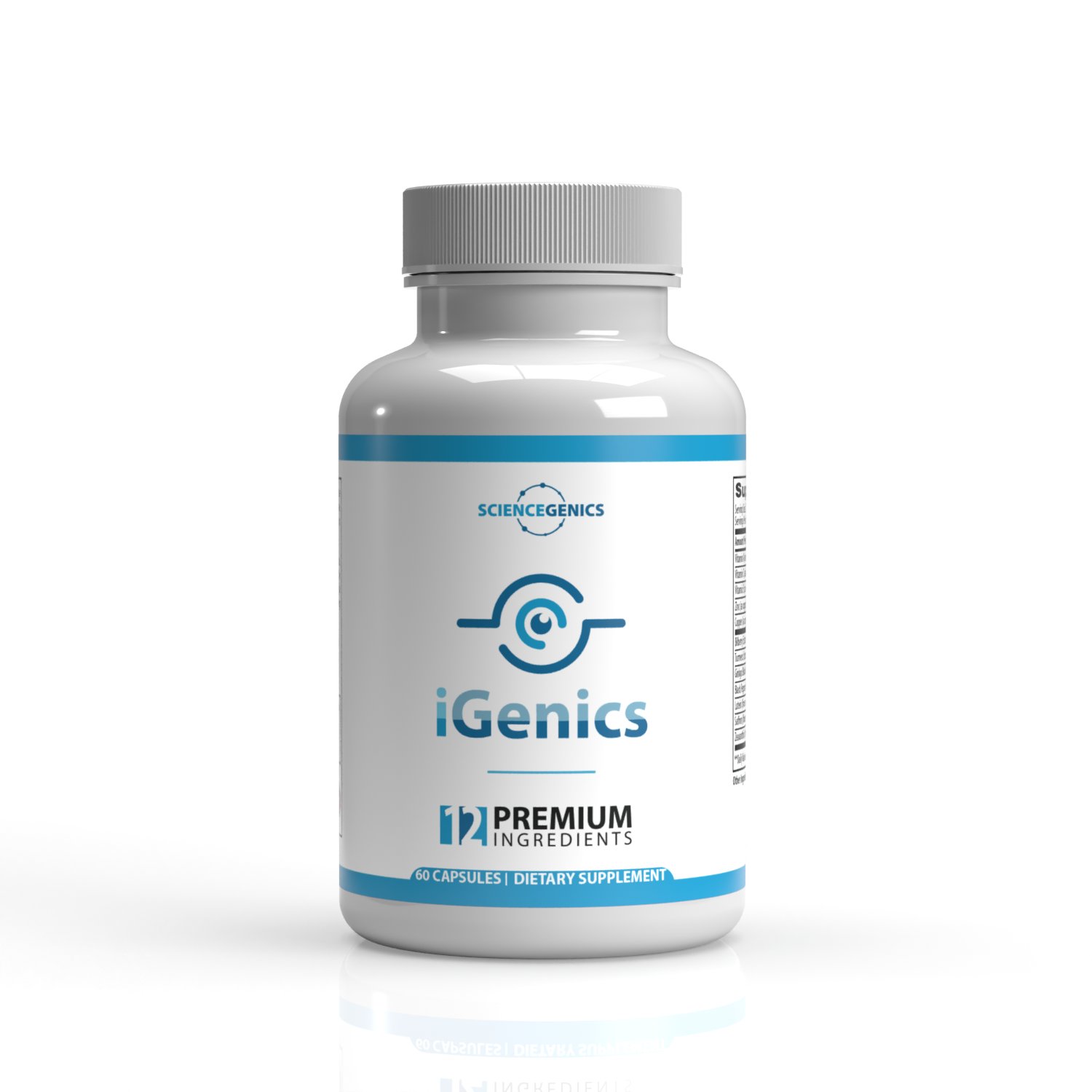
Introduction & What Is iGenics?
Vision decline is one of the few age-related changes almost nobody escapes, and one of the most unsettling: the print that needs more light, the road signs that arrive later at night, the prescription that creeps upward every couple of years. iGenics sells into that anxiety with a plant-based daily capsule built around bilberry extract, saffron, turmeric and the carotenoids lutein and zeaxanthin, with BioPerine (black pepper extract) added for absorption.
The formula's composition is worth noting up front, because it is a mix of the well-founded and the merely traditional. Lutein and zeaxanthin are the two carotenoids that concentrate in the macula and carry the most credible research in eye nutrition. Saffron has a small but genuinely interesting body of preliminary work. Bilberry, on the other hand, carries a famous World War II story about pilots and night vision that controlled studies have never confirmed.
iGenics targets adults, largely over 50, dealing with dimmer or cloudier vision, difficulty driving at night and prescriptions that keep changing. The manufacturer positions it as nutritional support for eye health, not as a treatment for eye disease, and that distinction matters more here than almost anywhere: several causes of worsening vision are progressive, treatable and time-sensitive.
Below: the ingredient-by-ingredient evidence, the night vision claim examined honestly, pros and cons, pricing with refund terms, and a realistic timeline. Disclosure, as on every page of this site: we are independent reviewers, and purchases through our links may earn us a commission at no additional cost to you.
How Does It Work?
iGenics rests on three proposed mechanisms. The first is macular pigment support: lutein and zeaxanthin accumulate in the macula, where they filter blue light and act as antioxidants. This is real physiology, and it is the mechanism behind the large AREDS2 trial that shapes mainstream eye nutrition. The second is antioxidant and anti-inflammatory support: saffron, turmeric and bilberry's anthocyanins are studied for oxidative-stress markers, on the logic that retinal tissue is metabolically demanding and vulnerable to oxidative damage. The third is absorption: BioPerine is included because curcumin in particular is poorly absorbed on its own, a legitimate formulation choice.
The mechanism story is coherent, but it carries an important limit worth stating plainly. Macular pigment support is about protecting retinal tissue over years, and the AREDS2 evidence applies specifically to people with intermediate age-related macular degeneration, not to the general population and not to blurry vision from other causes. Antioxidant support is a plausible hypothesis rather than a demonstrated clinical outcome for this formula.
The wider scientific picture: the carotenoid portion is the most defensible, with a large trial behind it in a specific population. Saffron's cognition-and-vision work is preliminary and mostly small. Bilberry's night vision reputation has not survived controlled testing. And the finished iGenics formula has no independent trials. Crucially, most reasons vision gets worse, cataracts, refractive change, glaucoma, diabetic retinopathy, are diagnosable conditions with real treatments; a supplement cannot address any of them, and time spent hoping it will is time a condition keeps progressing.
Core Ingredients Analysis
| Ingredient | What the manufacturer includes it for | Evidence snapshot |
|---|---|---|
| Lutein & zeaxanthin | Carotenoids that concentrate in the macula. | The strongest evidence here: AREDS2 supports a role in intermediate AMD progression, not in the general population. |
| Saffron extract | Antioxidant botanical for retinal support. | Small trials report modest effects on visual function in AMD; preliminary and mostly short-term. |
| Bilberry extract | The formula's night vision story. | Controlled studies have largely failed to confirm night vision benefits in people with normal vitamin A status. |
| Turmeric (curcumin) | Anti-inflammatory and antioxidant support. | Broad research base, poor absorption, little eye-specific clinical outcome data. |
| BioPerine (black pepper) | Enhances absorption of curcumin and other compounds. | Legitimate, documented absorption-enhancing role. |
What stands out positively: the carotenoid core reflects real eye-nutrition science rather than invention, and including BioPerine shows the formulator understood curcumin's absorption problem.
What deserves scrutiny: per-ingredient doses are not published in marketing materials, which is decisive here, the AREDS2 evidence rests on specific amounts of lutein and zeaxanthin, and a formula containing them at token levels would carry the association without the substance. Bilberry's presence is marketing heritage more than evidence. Label reading at purchase is not optional in this category.
Safety notes: turmeric and bilberry can affect blood clotting, relevant for anyone on anticoagulants; high-dose carotenoids should be discussed with a doctor by smokers, given the beta-carotene lung-cancer signal that reshaped AREDS2's formulation. Anyone with worsening vision needs an eye examination first, both to catch treatable disease and because a supplement can delay the diagnosis that matters. For screen-related eye discomfort specifically, see our article on digital eye strain symptoms and relief.
Real User Benefits & Drawbacks
Pros
- Carotenoid core reflects genuine eye-nutrition science, the same compounds studied in AREDS2.
- Saffron is an interesting, research-backed inclusion rather than filler, even if the data are preliminary.
- BioPerine addresses curcumin's real absorption problem, a sign of considered formulation.
- 60-day money-back guarantee processed through ClickBank's retail system.
Cons
- Doses are not disclosed, which is decisive when the headline evidence is dose-specific.
- The night vision framing rests on bilberry, whose controlled-trial record does not support it.
- AREDS2 evidence applies to a specific population with intermediate AMD, not to everyone with aging eyes.
- No independent trials of the finished formula; worsening vision needs an eye doctor, not a capsule.
Pricing, Packages & Refund Policy
iGenics is sold in single, 3-bottle and 6-bottle packages through the official website only. At the time of writing, a single bottle (a 30-day supply) is listed around $59, with bundles bringing the per-bottle price down toward $49 and below on the largest package, against higher stated regular pricing. Shipping terms vary by package, and ClickBank offers change frequently, so confirm live figures on the official page.
For scale, and this is the crucial context: AREDS2 measured its outcomes over roughly five years. Any honest comparison of package sizes against the evidence base means recognizing that this category's research operates on a timescale no six-bottle bundle covers.
The stated refund policy is a 60-day money-back guarantee on purchases made through the official website, processed through ClickBank's standard retail support. Keep the order confirmation email.
How It Compares to the Alternatives
Against an AREDS2 formula: for people whose eye doctor has diagnosed intermediate AMD, standard AREDS2 formulations are available at pharmacy prices, with doses matching the trial exactly. That is the evidence-matched option, and it is the comparison iGenics implicitly invites by including the same carotenoids.
Against food: lutein and zeaxanthin are abundant in leafy greens, egg yolks and corn. A diet including them regularly delivers the same compounds with the rest of a food matrix, at grocery prices.
Against other vision supplements: the shelf is crowded with near-identical carotenoid-plus-botanical blends, and the pattern repeats across the whole supplement category: the differentiator is rarely the science, which everyone shares, but the dosing transparency, which is usually missing.
Against an eye exam: the highest-value action for anyone whose vision is changing is a dilated eye examination. Cataracts, glaucoma, diabetic retinopathy and refractive change are all diagnosable, and most are treatable, in ways no supplement approaches. The exam is not an alternative to the supplement; it is the prerequisite to considering one.
What the Independent Research Actually Says
The trial that defines this category. The National Eye Institute's page on the AREDS and AREDS2 studies is the vendor-free reference: what was tested, in whom, and what it did and did not show. Anyone considering an eye supplement should read this first.
Bilberry and night vision. The famous story deserves a fact check; this PubMed search on bilberry and night vision shows the repeated failure of controlled trials to confirm the effect in people with normal vitamin A status.
Saffron's small but real signal. The most interesting preliminary ingredient here has genuine studies behind it; see this PubMed search on saffron and macular degeneration, keeping in mind the small sample sizes.
Why vision changes. The National Eye Institute's overview of eye conditions and diseases lays out the actual causes of declining sight, most of which need diagnosis and treatment rather than nutrition.
The regulatory frame. iGenics is regulated as food under the FDA's dietary supplement framework, with no pre-market efficacy review, which is why the refund policy carries weight in our verdict.
The wider context. If night driving is what brought you here, the causes are specific and optical, and some are treatable. Our guide to night vision and aging eyes covers glare, halos, slow dark adaptation, and the conditions worth ruling out with an exam.
What to Expect: A Realistic Timeline
- Weeks 1–4: Nothing measurable should be expected. Macular pigment changes slowly, and no ingredient here acts on vision within weeks. Perceived early improvements in this category are typically expectation, not optics.
- Months 2–6: The window where macular pigment optical density has shifted in studies of carotenoid supplementation. This is not something you can perceive; it is measured with equipment at an eye clinic.
- Years, not months: AREDS2's outcomes emerged over about five years, in a defined patient group. That timescale is the honest frame for this entire category, and it sits far outside any refund window.
The practical consequence: judge this product against your eye doctor's objective findings at scheduled examinations, not against how your vision feels on a given evening. Any sudden vision change, new floaters, flashes, or a curtain across your field of view is a medical emergency, not a supplement question.
Who the Evidence Applies To, and Who Should Avoid It
This is the section that matters most in the vision category, because the gap between the population studied and the population marketed to is unusually wide. AREDS2, the trial that gives lutein and zeaxanthin their credibility, enrolled people with intermediate age-related macular degeneration or advanced disease in one eye. Within that group, the carotenoid formulation was associated with a reduced rate of progression to advanced disease. That is a meaningful finding, and it describes a specific patient population identified by an eye doctor through examination.
It does not describe a person whose reading glasses have grown stronger, whose eyes tire at the end of a screen-heavy day, or who finds night driving harder than a decade ago. Those experiences have their own causes, presbyopia, dry eye, early cataract, refractive change, and the AREDS2 evidence says nothing about any of them. A product containing AREDS2's carotenoids inherits the association in marketing but not in applicability. Anyone whose eye doctor has actually diagnosed intermediate AMD is in the studied population, and for them the rational choice is a formulation matching the trial's doses exactly, which this product's undisclosed label cannot confirm.
Some groups need particular caution. Smokers, and recent former smokers, should not take carotenoid eye formulas without medical input: the original AREDS formula contained beta-carotene, which was linked to increased lung cancer risk in smokers, and that finding is precisely why AREDS2 replaced it with lutein and zeaxanthin. It is a case where the supplement field's own history contains a serious harm signal. People taking anticoagulants should discuss turmeric and bilberry, both of which can affect clotting. People with gallbladder disease should be cautious with high-dose curcumin.
And there is a group for whom this product is actively the wrong response: anyone experiencing sudden vision change, new floaters or flashes, a shadow or curtain across the field of vision, eye pain, or vision loss in one eye. Those are emergencies. Retinal detachment and acute glaucoma are measured in hours, and no supplement has any role in that conversation.
Frequently Asked Questions
What is iGenics?
A plant-based daily supplement marketed for vision support in aging eyes, built around bilberry, saffron, turmeric, lutein and zeaxanthin, with BioPerine for absorption. It is a supplement, not a medication.
Does iGenics improve vision?
Individual ingredients have research behind them, saffron and carotenoids most notably, but findings are preliminary or specific to certain conditions, and the finished formula is untested. The available evidence is insufficient to conclude it improves vision.
Can it help night vision?
Bilberry is traditionally linked to night vision, but controlled studies have largely failed to confirm that effect in people with normal vitamin A status. Worsening night vision deserves an eye examination.
How long does it take to work?
The manufacturer suggests consistent daily use over months. For context, the carotenoid research this category borrows from measured outcomes over years.
Where is it sold and what is the refund policy?
Through the official website with ClickBank checkout and a 60-day money-back guarantee processed through ClickBank's retail support.
Final Verdict: Is iGenics a Scam or Legit?
iGenics is structurally legitimate: named ingredients, ClickBank checkout, a 60-day refund route independent of the vendor, and a carotenoid core drawn from real eye-nutrition science rather than invention. The BioPerine inclusion suggests someone thought about absorption rather than just the label.
The problems are proof and framing. Doses are undisclosed in a category where the headline evidence is entirely dose-specific; the night vision angle leans on bilberry, whose controlled record does not support it; and the AREDS2 halo applies to a defined patient group rather than to everyone with aging eyes. The sequence the evidence supports: a dilated eye exam first, always, because most causes of declining vision are diagnosable and treatable; a diet with leafy greens and eggs next; an AREDS2-matched formula if a doctor identifies intermediate AMD; and only then, optionally, a product like this as an unproven addition on a timescale no refund window can measure.
Our rating: 3.9/5. Credited for a science-grounded carotenoid core, a thoughtful absorption choice and a working refund route; docked for undisclosed dosing, a night vision claim the literature does not support, and no product-level trials.