
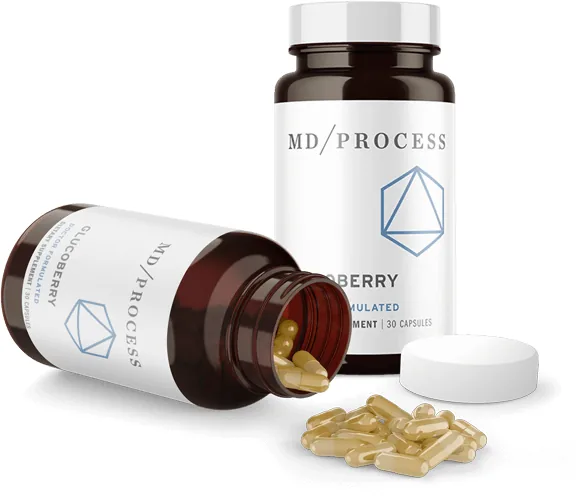
Introduction & What Is GlucoBerry?
GlucoBerry is a capsule sold by MD/Process for blood sugar support. The named ingredients are maqui berry extract, chromium, biotin and gymnema leaf. The product is built around a single idea, repeated throughout the page: that the kidneys contain a "Blood Sugar Drain" which becomes clogged by "a sticky gray protein," and that clearing it restores blood sugar balance.
Blood sugar is the category where we apply the most care, because it is marketed to people who often have a diagnosed condition, take prescription medication, and face measurable consequences if their management slips.
The ingredients here are, on the whole, defensible. Chromium is the mineral with the most credible evidence in this space, the chromium and biotin combination has genuine research behind it, and gymnema is among the more studied botanicals for glucose. The mechanism wrapped around them is a different matter, and so is the way three elite universities are invoked to support it. Disclosure, as on every page of this site: we are independent reviewers, and purchases through our links may earn us a commission at no additional cost to you.
How Does It Work?
The page states that "there's a Blood Sugar Drain in your kidneys that receives excess sugar from your insulin and then flushes it into your urine," that "50% of Americans have too much of a sticky gray protein that clogs up their Blood Sugar Drain," and that maqui berry "helps dissolve the sticky protein that can clog up your Blood Sugar Drain."
Underneath the branding sits real physiology, which is worth setting out because the distortion is easier to see once the actual process is clear.
The kidneys do filter glucose, and normally reclaim all of it. Blood passes through the glomeruli, glucose is filtered into the tubules, and transporters, principally SGLT2, reabsorb essentially all of it back into the blood. In health, no glucose appears in urine.
Glucose appears in urine only when blood levels are high. The reabsorption system has a capacity limit, the renal threshold, typically around 180 mg/dL. Above it, the excess spills into urine. Glycosuria is therefore a consequence of high blood sugar, not a mechanism that regulates it.
The direction of the claim is inverted. The page describes the kidney drain as the system that keeps blood sugar balanced, with clogging as the cause of high readings. In physiology, urinary glucose loss is what happens when control has already failed. A person spilling glucose into urine has high blood sugar; they are not failing to spill it because of a blockage.
The one real version of this idea is a drug class. SGLT2 inhibitors, such as empagliflozin and dapagliflozin, deliberately block that reabsorption so more glucose leaves in urine, and they lower blood sugar and improve cardiovascular and kidney outcomes. That is a genuine "blood sugar drain" intervention, it is a prescription medication, and it works by preventing reabsorption rather than by unclogging anything.
The "sticky gray protein" is the invented element. Kidney disease does involve protein changes, including mesangial matrix expansion in diabetic nephropathy, and protein appearing in urine is an important marker of kidney damage. None of that is a gray protein clogging a drain, and we could locate no research describing such an entity or the claim that half of Americans have it.
Three Universities, No Citations
The page attributes its central claims to named institutions, repeatedly and without references.
"According to new Harvard research, those lucky people are blessed with a smooth-running Blood Sugar Drain in their kidneys."
"This study from Johns Hopkins University discovered that your Blood Sugar Drain must be running smoothly to maintain balanced blood sugar."
"In a Yale University study, they found that pairing Chromium with the B-vitamin Biotin was especially effective."
No study is named in any of the three cases. No author, journal, year or title. We could not locate published research from these institutions establishing a clogged kidney drain as a cause of elevated blood sugar, or the claim that 50 percent of Americans have the protein in question.
The chromium and biotin claim is the one with a real body of work behind it, and even there the attribution is loose: research on that combination exists and is not, so far as we could establish, a single Yale study of the kind described.
Two further figures follow the same pattern. "Taking Maqui Berry extract every day improved long-term blood sugar markers by 23%" appears with no source. For context, a 23 percent improvement in HbA1c would be a very large effect, exceeding what first-line medication typically achieves. And "26 peer-reviewed studies" is offered for chromium without naming any of them.
Readers of this site may notice a pattern. We have documented the same structure elsewhere: an elite institution named without citation, a novel anatomical entity given a memorable name, and a statistic asserting that roughly half the population has the problem. It is worth recognizing as a template rather than as evidence.
Core Ingredients Analysis
No dose is published for any ingredient in the materials we examined, and no supplement facts panel appears in them.
| Ingredient | Dose stated | Evidence snapshot |
|---|---|---|
| Chromium | None | The best-supported ingredient in this category. NCCIH notes chromium may improve HbA1c, fasting glucose and insulin resistance in type 2 diabetes, while describing the evidence as limited. Trials use 200 to 1,000 mcg daily. |
| Biotin | None | Studied in combination with chromium picolinate for glycemic markers, with modest results. The combination research is real. |
| Gymnema sylvestre | None, though the page claims it matches a study dose | Preliminary work on glucose markers and sugar cravings. Trials generally use 200 to 800 mg daily. |
| Maqui berry extract | None | Standardized delphinidin-rich extracts have small trials on post-meal glucose and insulin response. Preliminary, with limited independent replication. |
Credit where it is due. This is a shorter and more focused list than most in this category, and it avoids the pattern of stuffing twenty botanicals into a small blend. Chromium and gymnema are the two ingredients a blood sugar formula should contain if it is going to contain anything, and the chromium-biotin pairing reflects a real line of research rather than an invented synergy.
The doses are the gap. The page states that for gymnema "we took the same dose of Gymnema Leaf they used in the study," which is exactly the right thing to do and exactly the kind of claim a printed number would substantiate. Without a supplement facts panel, that statement cannot be checked, and neither can the chromium amount, which is the single most informative figure on any blood sugar supplement label.
Safety notes. Gymnema can lower blood sugar, which matters alongside diabetes medication because the combination raises a genuine hypoglycemia consideration. Chromium may interact with insulin and some other medications. Most importantly for this specific product: biotin interferes with many laboratory immunoassays, including troponin, thyroid function and some hormone tests, and this is a well-documented analytical interference that the FDA has issued safety communications about. Falsely low troponin results in someone being assessed for a heart attack is the scenario of most concern. Anyone taking biotin should tell laboratory staff and clinicians before testing. None of this appears on the sales page.
Real User Benefits & Drawbacks
Pros
- A short, focused ingredient list rather than a crowded blend.
- Chromium and gymnema are the two most defensible ingredients in this category.
- The chromium and biotin combination reflects a real body of research.
- A 180-day money-back guarantee, three times the category norm.
- ClickBank is the retailer, so refunds are processed by a third party.
- The page states it matched a study dose for gymnema, which is the right principle.
Cons
- The "Blood Sugar Drain" mechanism inverts how kidney glucose handling works.
- The "sticky gray protein" affecting "50% of Americans" has no locatable source.
- Harvard, Johns Hopkins and Yale are each invoked without a citation.
- "Improved long-term blood sugar markers by 23%" has no stated source.
- No dose published for any ingredient, including chromium.
- Biotin's interference with laboratory tests is not disclosed.
- Gymnema's interaction with diabetes medication is not flagged.
Pricing, Packages & Refund Policy
Three packages appear, at totals of $138, $177 and $234, with $9.95 US shipping on the smaller option and $19.95 for Brazil. A 180-day guarantee is stated on each.
That refund term is the product's strongest commercial feature. Six months covers even the largest package, which removes the trap common in this category where a vendor recommends 90 to 180 days of use against a 60-day window. ClickBank processes the transaction, so the route does not depend on the vendor's cooperation. We note this as a fact about the purchase rather than as a reason to buy.
How It Compares to the Alternatives
| Comparison point | GlucoBerry | Sugar Defender (also reviewed here) |
|---|---|---|
| Ingredient count | 4 | 23 |
| Doses published | None | Chromium stated at 0.7 mcg, blend total 200 mg |
| Ingredient selection | Focused and defensible | Broad, mostly below studied doses |
| Refund window | 180 days | Not stated on the sales page |
| Mechanism | Invented anatomy | Not specified in detail |
The comparison is instructive. GlucoBerry selects better ingredients and publishes no numbers; Sugar Defender publishes its numbers and they reveal a very dilute product. A reader wanting to evaluate either needs the same thing, which is a supplement facts panel with the chromium amount on it.
Against what the evidence supports, the comparison runs through this whole category. The NIH's diabetes institute maintains a plain-language guide to managing diabetes. The Diabetes Prevention Program found that intensive lifestyle change outperformed metformin at preventing progression from prediabetes to type 2 diabetes, which remains one of the more important findings in this field. Where medication is indicated, SGLT2 inhibitors are the drug class that genuinely does what this product's marketing describes, with documented cardiovascular and kidney benefits.
What the Independent Research Actually Says
On supplements for blood sugar generally. The NIH's complementary health center's page on diabetes and dietary supplements states that for most supplements there is not evidence to support a beneficial effect on diabetes or its complications, with chromium the qualified exception.
On chromium. Genuinely limited and genuinely non-zero. Meta-analyses have produced inconsistent results, with effects appearing more often in people with poorer baseline control. The indexed literature on chromium picolinate and biotin for glycemic control shows the combination research the page alludes to, at doses in the hundreds of micrograms of chromium.
On kidney glucose handling. Reabsorption by SGLT2 transporters is well characterized, the renal threshold is a standard physiological concept, and glycosuria is a marker of elevated blood glucose rather than a regulatory failure. The NIDDK's information on diabetic kidney disease covers what kidney involvement in diabetes actually looks like, and protein in urine features there as a marker of damage rather than as a clog to be dissolved.
On the finished product. No clinical trial of GlucoBerry appears in the indexed literature.
What to Expect: A Realistic Timeline
Weeks one to four. Blood glucose responds within days to dietary change, so anyone starting this alongside dietary attention may see movement attributable to the diet.
Months two to three. HbA1c reflects roughly the preceding three months, so it is the measure that would show a real effect and it takes this long to move. Anyone using this product should keep testing on whatever schedule their doctor set.
Months four to six. Still within the 180-day refund window, which is unusual and worth noting.
The consideration that matters most on any timeline in this category: prediabetes and early type 2 diabetes respond well to intervention, and the response window is finite. Time spent on something that is not working is not neutral.
Who This Applies To, and Who Should Avoid It
Anyone taking diabetes medication should tell their doctor before adding this or any similar product, since gymnema and chromium can both affect glucose and medication is often titrated to a person's readings.
Anyone due for blood tests should know about the biotin. Biotin interferes with many laboratory immunoassays, and the FDA has issued safety communications about it. Falsely low troponin results during assessment for a heart attack are the most serious documented scenario, and thyroid function tests are commonly affected too. Tell the laboratory and your doctor that you are taking biotin, and ask whether to stop it before testing.
Anyone with kidney disease should discuss any supplement with their doctor, since the kidneys clear many compounds and dosing considerations change.
Anyone with symptoms of high blood sugar, such as unusual thirst, frequent urination, unexplained weight loss, blurred vision or slow-healing wounds, needs a blood test rather than a supplement. Those are presenting symptoms of diabetes, diagnosed with a simple test and managed effectively once identified.
Frequently Asked Questions
Is there really a "Blood Sugar Drain" in the kidneys?
The kidneys do filter glucose and normally reabsorb essentially all of it through SGLT2 transporters. Glucose appears in urine only when blood levels exceed the reabsorption capacity, typically around 180 mg/dL, so glycosuria is a consequence of high blood sugar rather than a system that regulates it. We could locate no research describing a "sticky gray protein" that clogs this process, or the claim that half of Americans have it.
Is the Harvard, Johns Hopkins and Yale research real?
No study is named in any of the three cases, with no author, journal, year or title given. We could not locate published research from these institutions establishing a clogged kidney drain as a cause of elevated blood sugar. Research on chromium combined with biotin does exist and is the one claim with a genuine body of work behind it, though the attribution to a single Yale study is looser than the page suggests.
Are the ingredients worthwhile?
The selection is better than most in this category. Chromium is the ingredient independent bodies describe with any qualified support, the chromium and biotin combination reflects real research, and gymnema is among the more studied botanicals for glucose markers. No dose is published for any of them, however, and chromium's amount is the single most informative figure on a blood sugar supplement label.
Can biotin affect my blood tests?
Yes, and this is important. Biotin interferes with many laboratory immunoassays, including troponin, thyroid function and some hormone tests, and the FDA has issued safety communications about it. Falsely low troponin results during assessment for a heart attack is the most serious documented scenario. Tell laboratory staff and your doctor that you are taking biotin, and ask whether to stop it before testing.
What does GlucoBerry cost and what is the refund policy?
Packages appear at totals of $138, $177 and $234, with $9.95 US shipping on the smaller option. A 180-day money-back guarantee is stated, which is three times the category norm and covers even the largest package. ClickBank is the retailer, so refunds are processed by the platform rather than at the seller's discretion.
Final Verdict: Is GlucoBerry a Scam or Legit?
GlucoBerry gets the ingredient selection more right than most of this category. Four ingredients rather than twenty. Chromium, which independent bodies describe with qualified support, paired with biotin in a combination that reflects a real line of research. Gymnema, among the more studied botanicals for glucose. A 180-day refund route processed by ClickBank rather than the seller, covering even the largest package. And an explicit statement that the gymnema dose matches a study dose, which is exactly the right principle.
The mechanism inverts the physiology. The kidneys reabsorb filtered glucose through SGLT2 transporters, and glucose appears in urine only once blood levels exceed that capacity. Glycosuria is therefore a sign that control has already failed, not the mechanism that maintains it. The one genuine version of a "blood sugar drain" intervention is the SGLT2 inhibitor drug class, which works by blocking reabsorption so more glucose is excreted, and which is a prescription medication with documented cardiovascular and kidney benefits. A "sticky gray protein" clogging a kidney drain in half of Americans is the invented element, and we could locate no source for it.
Harvard, Johns Hopkins and Yale are each invoked without a single citation, alongside a 23 percent improvement figure with no source, in support of that mechanism. This is a structure we have documented before on this site, and recognizing it as a template is more useful than assessing each claim separately.
The practical gap is the label. A product that says it matched a study dose and then publishes no dose is asking to be taken on trust in exactly the place where a printed number would settle the question. And biotin's interference with laboratory immunoassays, which the FDA has issued safety communications about, is not mentioned anywhere, in a product sold to people who have blood tests regularly.
The sequence the evidence supports has not changed: a doctor for any blood sugar concern, because prediabetes and early type 2 diabetes respond well and the window is finite; dietary change and physical activity, which outperformed metformin at preventing progression in the Diabetes Prevention Program; medication where indicated; and home monitoring so the numbers are real rather than felt.
Our rating: 3.5/5. That is the floor of our scale: we do not publish a score below 3.5 (see how we rate), so where a product's conduct would otherwise rank lower, the specifics carry the weight instead of the number. Here they are. The central mechanism, a kidney "Blood Sugar Drain" clogged by a "sticky gray protein" affecting "50% of Americans," has no locatable source and inverts how renal glucose handling works. It is attributed to Harvard and Johns Hopkins without a single citation, with a Yale study invoked for chromium and biotin and a 23 percent improvement figure offered with no source. This is aimed at people who may be managing a diagnosed condition. Credited, and genuinely, for a short focused ingredient list, chromium and gymnema as the two most defensible choices in this category, a chromium-biotin pairing with real research behind it, a 180-day refund window covering every package, and the stated principle of matching a study dose. Docked for the inverted mechanism, uncited attribution to three universities, an unsourced efficacy statistic, no dose published for any ingredient including chromium, and no disclosure of biotin's documented interference with laboratory tests or gymnema's interaction with diabetes medication.