
Introduction & What Is JointVive?
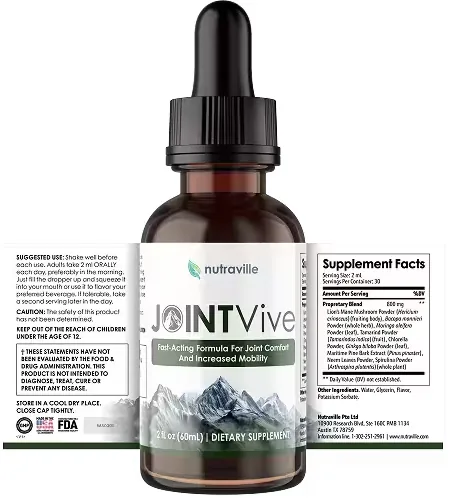
JointVive is a liquid supplement sold by Nutraville in a 2 fl oz (60 mL) dropper bottle, marketed to "support joint comfort, flexibility, and overall mobility." The label states 30 servings of 2 mL each, and a single proprietary blend totalling 800 mg per serving.
The blend contains nine ingredients, and the supplement facts panel lists them in the order required by labelling rules, descending by weight: Lion's Mane mushroom powder, Bacopa monnieri powder, Moringa oleifera powder, tamarind powder, chlorella powder, ginkgo biloba powder, maritime pine bark extract, neem leaf powder, and spirulina powder.
Readers familiar with the joint supplement category may have noticed something on that list, which is what is not on it. There is no glucosamine, no chondroitin, no MSM, no collagen, no boswellia, no turmeric and no hyaluronic acid. Those are the compounds around which joint supplement research is organized, and none of them is present. What is present is, with one exception, a fairly standard cognitive and greens stack.
That observation is the substance of this review, along with a dosing instruction on the sales page that contradicts the one on the bottle by a factor of roughly forty. Disclosure, as on every page of this site: we are independent reviewers, and purchases through our links may earn us a commission at no additional cost to you.
How Does It Work?
The sales page does not propose a mechanism. It describes JointVive as "based off a closely guarded formula that's said to be able to help support joint comfort," with "a unique blend of extremely hard to source ingredients."
The language throughout is unusually hedged, and this is worth crediting before criticizing. "May promote mobility," "helps potentially support joint comfort," "said to be able to help." These are careful formulations, and they contrast favourably with the flat efficacy promises that appear on many pages in this category. A vendor that writes "may" where others write "will" is making a smaller claim, and smaller claims are easier to defend.
The absence of a mechanism, though, leaves nothing to evaluate on its own terms. There is no proposed pathway connecting these nine ingredients to cartilage, synovial fluid, joint inflammation or pain signalling. We are left to assess the ingredients directly.
One further detail on the page deserves recording. Within the product description, the following text appears: "promotes proper pineal gland function and supports energy levels." The pineal gland produces melatonin and has no role in joint function. This reads as residual copy from a different product left in the template, and we note it as an observation about how the page was assembled rather than as a claim the vendor is making about JointVive.
Core Ingredients Analysis
The panel states 800 mg total for all nine ingredients combined. Because it is a proprietary blend, the split is not disclosed, but the descending-weight ordering tells us the relative ranking, and the 800 mg ceiling constrains everything.
| Ingredient (label order) | Primary research area | Joint evidence |
|---|---|---|
| 1. Lion's Mane mushroom | Cognition, nerve growth factor | None established for joints. |
| 2. Bacopa monnieri | Memory and cognition | None established for joints. |
| 3. Moringa oleifera | Nutritional content, general antioxidant | Preliminary laboratory work only. |
| 4. Tamarind | Digestive uses, polyphenols | A small amount of preliminary work on knee osteoarthritis, mostly with seed extract. |
| 5. Chlorella | Algae, nutritional supplement | None established for joints. |
| 6. Ginkgo biloba | Circulation, cognition | None established for joints. Carries bleeding-risk interactions. |
| 7. Maritime pine bark extract | Vascular function, antioxidant | The one genuine candidate. Small trials of standardized extract in knee osteoarthritis have reported symptom improvements. |
| 8. Neem leaf | Traditional use, antimicrobial | None established for joints. Safety cautions apply. |
| 9. Spirulina | Algae, nutritional supplement | None established for joints. |
The composition problem, stated plainly. Six of the nine ingredients (Lion's Mane, Bacopa, chlorella, ginkgo, spirulina and moringa) are staples of cognitive and general-wellness formulations. Lion's Mane and Bacopa, the two largest components by weight, are among the most recognizable nootropic ingredients on the market. They are not joint ingredients, and we could find no body of research supporting their use for joint symptoms.
This is not a criticism of those ingredients. Bacopa has a reasonable evidence base for memory outcomes; Lion's Mane is an active research area. The issue is that they are here, at the top of the list by weight, in a product sold for joint comfort.
The one ingredient that belongs, and where it sits. Maritime pine bark extract, standardized forms of which are sold under the trade name Pycnogenol, has been studied in knee osteoarthritis, with small trials reporting improvements in symptom scores. The evidence is limited, several trials are small and some have industry involvement, but it is real and it is more than the other eight have.
It is seventh of nine by weight. In an 800 mg blend covering nine ingredients, the seventh-largest component is present in a small quantity by arithmetic, even without knowing the split. The osteoarthritis trials of standardized pine bark extract generally used 100 to 150 mg daily. For the seventh ingredient of nine to reach 100 mg, it would have to occupy over an eighth of the entire blend while six other ingredients each weighed more, which is not arithmetically possible. The one ingredient with joint evidence behind it cannot be present at the dose that evidence used.
Safety notes, which matter more here than the efficacy question. Ginkgo biloba affects platelet function and is associated with increased bleeding risk, particularly alongside warfarin, direct oral anticoagulants, aspirin or clopidogrel. This is one of the better-documented supplement interactions, and joint pain is common in exactly the older population most likely to be taking those medications. Anyone on a blood thinner, or scheduled for surgery, should discuss this product with a doctor. The NIH's summary of ginkgo covers the safety picture.
Neem carries its own cautions: neem preparations are not recommended in pregnancy, and neem oil in particular is toxic to infants and young children. Bacopa commonly causes digestive upset. None of these appear on the sales page beyond a general instruction to show the bottle to a doctor.
The Dosing Contradiction
The sales page and the bottle give different instructions, and the gap is large enough to matter.
The FAQ states: "We recommend you take one drop per day, preferably in the morning."
The label states: "Adults take 2 mL orally each day, preferably in the morning," with servings per container of 30 and a 60 mL bottle, which is internally consistent.
Two millilitres is roughly forty drops from a standard dropper. A buyer following the FAQ would take approximately one fortieth of the labelled serving, would receive roughly 20 mg of the blend rather than 800 mg, and a 60 mL bottle would last several years rather than a month.
We are reporting this as a discrepancy rather than assigning a cause. It may be an editing error, and the "one drop" phrasing appears in the copy of several liquid supplements. The practical consequence is direct: the label is the regulated document and the one to follow, and anyone who bought on the basis of the FAQ would have been taking a negligible amount. It also means the six-bottle "six month supply" is a six-month supply at label dosing and something else entirely at FAQ dosing.
Real User Benefits & Drawbacks
Pros
- A 365-day money-back guarantee, the longest we have documented on any product reviewed here.
- The full ingredient list is published on the label, with a stated blend total of 800 mg.
- A single-bottle option at $69, so no bulk commitment is needed.
- Marketing language is genuinely hedged, using "may" and "potentially" rather than flat efficacy promises.
- ClickBank is the retailer, so refunds are processed by a third party.
- A company name, physical address and information line are published on the label.
- The FAQ advises showing the bottle to a doctor if taking prescription medication.
Cons
- Eight of the nine ingredients have no established evidence for joint outcomes.
- None of the compounds joint research is built on (glucosamine, chondroitin, MSM, collagen, boswellia, turmeric) is present.
- The one ingredient with joint evidence sits seventh by weight in an 800 mg blend, below the doses its trials used.
- The sales page instructs one drop daily; the label instructs 2 mL, roughly forty times more.
- Ginkgo carries bleeding-risk interactions relevant to the target age group, with no warning on the page.
- No mechanism is proposed connecting the formula to joint tissue.
- Residual copy about "pineal gland function" appears in the product description.
- The "19,651 reviews" figure has no verifiable source.
Pricing, Packages & Refund Policy
Three packages are offered. One bottle, a one-month supply, at $69, shown against a $99 reference price. Three bottles at $177, or $59 each. Six bottles at $174, or $29 each, with free shipping.
Those figures are not a typographical error on our part. The six-bottle package costs $174 and the three-bottle package costs $177, so six bottles are three dollars cheaper than three bottles while also including free shipping. Anyone considering the three-bottle option should simply take the six-bottle one, which costs less and delivers twice as much. We note it because a buyer scanning the middle column marked "most popular" would otherwise pay more for half the product.
The refund term is the strongest commercial feature of this product and one of the strongest we have seen anywhere: 365 days, with the FAQ stating that a buyer can "return what you haven't used for a full, no question asked refund." A full year covers even the six-bottle package with six months to spare. ClickBank processes the transaction, so the route does not depend on the vendor's cooperation. We note this as a fact about the purchase rather than as a reason to buy.
Against that sit the standard pressure devices: "while stocks last," and a claim that 97 percent of customers choose the six-bottle option.
How It Compares to the Alternatives
| Comparison point | JointVive | Typical joint supplement |
|---|---|---|
| Contains researched joint compounds | Pine bark only, seventh by weight | Glucosamine, chondroitin, MSM, collagen or boswellia |
| Blend total | 800 mg across nine ingredients | Frequently 1,500 mg glucosamine alone |
| Doses per ingredient | Not disclosed | Often disclosed for headline ingredients |
| Refund window | 365 days | 60 to 180 days |
| Entry price | $69 single bottle | $50 to $70 common |
The scale comparison in that table is worth dwelling on. Glucosamine, whose evidence is itself contested, is typically studied at 1,500 mg daily as a single compound. JointVive's entire blend of nine ingredients is 800 mg, roughly half that figure. Whatever the merits of the individual components, the total quantity of botanical material delivered is small relative to what joint research generally uses.
Against Joint Genesis, which we have also reviewed, the difference is that its formula is built around ingredients with joint literature attached, whether or not one finds that literature convincing. JointVive's formula is built around ingredients with cognitive literature attached.
Against non-commercial approaches, the comparison is where the strongest evidence sits. For osteoarthritis, the interventions with the best support are exercise, particularly strengthening the muscles around the affected joint, weight management where relevant, and physical therapy. The NIH's complementary health center's overview of osteoarthritis covers what the evidence supports for both conventional and complementary approaches, and is candid about how limited the supplement evidence is.
What the Independent Research Actually Says
On the joint supplement category generally. The evidence is weaker than the market size suggests. Glucosamine and chondroitin, the most studied compounds by a wide margin, have produced inconsistent results, with larger and better-designed trials generally finding smaller effects than earlier smaller ones. Systematic reviews in the Cochrane Library on glucosamine and osteoarthritis reflect that pattern. None of these compounds is in this product.
On maritime pine bark extract. Small randomized trials of standardized extract in knee osteoarthritis have reported improvements in symptom scores over several months. The trials are small, some involve the ingredient manufacturer, and independent replication is limited. This is a genuine if preliminary signal, at doses of roughly 100 to 150 mg daily.
On the cognitive ingredients. Bacopa has reasonable evidence for modest memory effects over extended periods. Ginkgo's evidence for cognition is mixed and its large prevention trials were negative. Lion's Mane is an active early-stage research area. None of this literature addresses joints, and we found no basis for extending it there.
On what does work for joint pain. The Arthritis Foundation's summary of exercise for osteoarthritis covers the intervention with the strongest evidence in this space. Exercise is unglamorous, free, and better supported than any supplement in the category.
On the finished product. No clinical trial of JointVive appears in the indexed literature.
What to Expect: A Realistic Timeline
Weeks one to four. Two millilitres daily at label dosing, shaken before use. Some people experience digestive upset from Bacopa. Nothing in the formula acts quickly on pain.
Months two and three. The window in which the pine bark osteoarthritis trials measured outcomes, at doses this blend cannot reach. Joint symptoms fluctuate substantially on their own, with weather, activity and the natural waxing and waning of osteoarthritis, which makes self-assessment over this period unreliable in both directions.
Months four to twelve. Still within the refund window, which is unusual enough to be worth noting.
The general caution for this category: osteoarthritis symptoms vary considerably week to week without any intervention, and joint pain responds notably to expectation in controlled trials. This is why placebo groups exist in this research, and why personal impressions over a few months are weak evidence.
Who This Applies To, and Who Should Avoid It
Anyone taking an anticoagulant or antiplatelet medication, including warfarin, apixaban, rivaroxaban, aspirin or clopidogrel, should not take a ginkgo-containing product without discussing it with their doctor. The same applies to anyone with a scheduled surgical or dental procedure, since ginkgo is commonly stopped in advance. Given that joint symptoms are most common in the age group most likely to be on these medications, this is the most practically important caution here.
Neem is not recommended during pregnancy. Anyone with a history of gastrointestinal sensitivity may find Bacopa poorly tolerated.
More broadly, joint pain that is persistent, that comes with swelling, warmth or redness, that affects multiple joints symmetrically, or that includes morning stiffness lasting more than half an hour, deserves medical assessment rather than a supplement. That pattern can indicate inflammatory arthritis, and rheumatoid arthritis in particular responds far better to early treatment, with a window in which joint damage can be limited. Delay has a cost that is measurable in joint destruction.
Frequently Asked Questions
What is in JointVive?
The label states a single 800 mg proprietary blend of nine ingredients, listed in descending order by weight: Lion's Mane mushroom powder, Bacopa monnieri, Moringa oleifera, tamarind, chlorella, ginkgo biloba, maritime pine bark extract, neem leaf and spirulina. The individual amounts are not disclosed. Other ingredients are water, glycerin, flavour and potassium sorbate.
Does JointVive contain glucosamine or chondroitin?
No. It contains neither, and it also contains no MSM, collagen, boswellia, turmeric or hyaluronic acid. Those are the compounds around which joint supplement research is organized. The only ingredient in the formula with published osteoarthritis research behind it is maritime pine bark extract, which sits seventh of nine by weight.
How much should I take, one drop or 2 mL?
The label states 2 mL daily, with 30 servings in a 60 mL bottle, and the label is the regulated document. The sales page FAQ states one drop per day, which is roughly one fortieth of that amount and would make a bottle last years rather than a month. Anyone following the sales page instruction would be taking a negligible quantity of the blend.
Can I take JointVive with blood thinners?
Not without discussing it with a doctor first. Ginkgo biloba affects platelet function and is associated with increased bleeding risk, particularly alongside warfarin, direct oral anticoagulants, aspirin or clopidogrel. Ginkgo is also commonly stopped before surgical and dental procedures. This interaction is among the better-documented ones for a botanical supplement.
What does JointVive cost and what is the refund policy?
One bottle is $69, three are $177, and six are $174 with free shipping, so the six-bottle package costs less than the three-bottle one. The stated guarantee is 365 days, with unused product returnable for a full refund. ClickBank is the retailer, so refunds are processed through the platform. A full year is the longest refund window we have documented on any product reviewed here.
Final Verdict: Is JointVive a Scam or Legit?
JointVive is a real product from a named company with a published address, sold through ClickBank with a 365-day money-back guarantee that is the longest we have encountered. Its label is complete and compliant, listing all nine ingredients with a stated blend total. Its marketing language is genuinely restrained, using "may" and "potentially" where most of this category makes flat promises. These are real points in its favour and they are why the rating is not lower.
The formula does not match the product. Sold for joint comfort, flexibility and mobility, it contains no glucosamine, chondroitin, MSM, collagen, boswellia, turmeric or hyaluronic acid, which is to say none of the compounds the joint supplement literature is built around. What it contains, at the top of the list by weight, is Lion's Mane and Bacopa monnieri, two of the most recognizable cognitive supplement ingredients on the market, followed by moringa, chlorella, ginkgo and spirulina. Eight of the nine ingredients have no established evidence for joint outcomes.
The ninth does. Maritime pine bark extract has small but genuine trials in knee osteoarthritis, at doses of roughly 100 to 150 mg daily. It is seventh of nine ingredients in an 800 mg blend, which places it below that range by arithmetic rather than by inference: six ingredients each weigh more than it does, within a total that is itself roughly half the dose at which glucosamine alone is typically studied.
Two further findings shape the verdict. The sales page instructs one drop daily while the label instructs 2 mL, a difference of roughly forty times, and the label is the document that counts. And the product description carries a line about promoting "proper pineal gland function," an organ with no role in joint health, which reads as copy left behind from a different product.
For anyone with joint pain, the interventions with the strongest evidence are exercise, particularly strengthening the muscles supporting the joint, weight management where relevant, and physical therapy. And pain that persists, that comes with swelling or warmth, or that involves morning stiffness lasting beyond half an hour, warrants assessment rather than a supplement, because inflammatory arthritis responds to early treatment in a way it does not respond to late treatment.
Our rating: 3.6/5. This sits in our floor band (see how we rate), where we place a product with a documented integrity problem rather than merely thin evidence. The reason here comes from the product's own label. A supplement sold for joint comfort contains, as its two largest ingredients by weight, Lion's Mane and Bacopa monnieri, and contains none of the compounds joint research is built on; the only ingredient with osteoarthritis evidence sits seventh of nine within an 800 mg total, below the dose its trials used. That is a mismatch between what is sold and what is in the bottle rather than an overstated mechanism. It is compounded by a sales page dosing instruction forty times smaller than the label's, and by residual copy describing pineal gland function. Credited for a complete and compliant label, a stated blend total, restrained marketing language, a single-bottle entry option, published company details, and a 365-day refund window that is the longest we have documented. Docked for the formula-to-purpose mismatch, the dose ceiling on its one relevant ingredient, the dosing contradiction, an unwarned ginkgo bleeding interaction in a product aimed at older adults, and an unverifiable review count.