
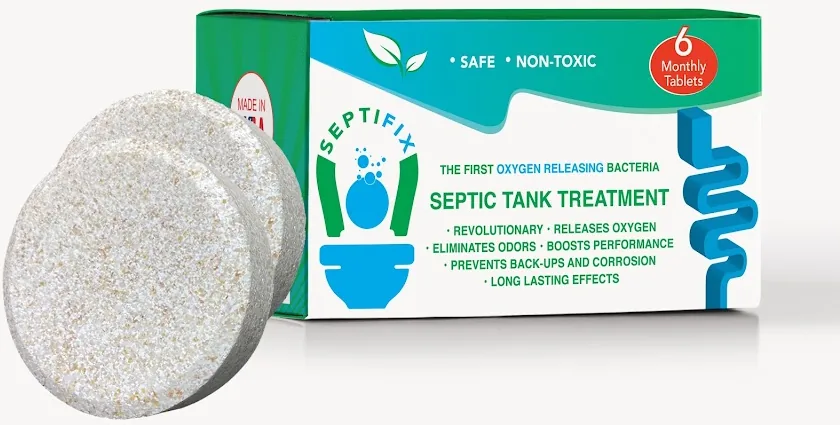
Introduction & What Is Septifix?
Septifix is a septic tank treatment sold as 55-gram tablets flushed down a toilet, one per month after an initial dose of three. The box states six monthly tablets. The marketing describes the tablets as oxygen-releasing, containing 14 strains of aerobic bacteria plus sodium carbonate as a pH buffer.
This is the only non-health product in this batch, and the evaluation runs differently. There is no dose arithmetic against clinical trials, because septic maintenance is an engineering and public health question rather than a medical one. There is, usefully, a clear federal position on both septic maintenance generally and tank additives specifically, which gives an independent benchmark that most categories lack.
One claim on this page carries more weight than everything else, and it is the reason to read carefully before buying. The product states that it will "reduce, and in many cases, eliminate the need to have your septic tank pumped." Whether that is true determines not whether a buyer wastes $69, but whether they risk the single most expensive failure a septic system can have. Disclosure, as on every page of this site: we are independent reviewers, and purchases through our links may earn us a commission at no additional cost to you.
How Does It Work?
The described mechanism has three parts.
Oxygen release. Each tablet is said to release "up to 10 liters of oxygen," dispersed as small bubbles through the tank.
pH buffering. Sodium carbonate is released to bring tank water toward neutral pH, creating conditions for the added bacteria.
Aerobic bacteria. Fourteen strains are added, described as "over 10 billion bacteria strains per gram," to break down sludge, grease and organic matter.
Each of these describes something real, and each raises a question of scale that the page does not address.
On the oxygen. A residential septic tank typically holds 1,000 to 1,500 gallons, roughly 4,000 to 5,700 litres. Ten litres of oxygen released gradually into that volume, once a month, is a small quantity relative to the tank. The page itself makes the comparison that undercuts the claim: it notes that septic systems designed to run aerobically use mechanical aerators costing over $10,000 to install plus ongoing electricity. Those units run continuously, precisely because maintaining aerobic conditions in a tank of that size requires continuous energy input. A monthly tablet and a continuously powered aerator are not the same intervention at different price points.
On the bacteria. A conventional septic tank is anaerobic by design, and that is not a defect to be corrected. Anaerobic digestion is the process the tank is engineered around. Aerobic treatment units exist as a distinct system type with different construction, permitting and maintenance requirements. Introducing aerobic bacteria into an anaerobic environment means introducing organisms into conditions where they do not thrive.
On the claim to destroy anaerobic bacteria. The page states the tablets "destroy all the bad anaerobic bacteria like e-coli or salmonella and other harmful pathogens." Two problems here. Anaerobic bacteria are the primary functional decomposers in a conventional septic tank, so eliminating them would impair the process the tank depends on. And E. coli is a facultative anaerobe rather than an obligate one, which is a small technical point that matters because it suggests the categories are being used loosely.
On the counting. "Over 10 billion bacteria strains per gram" is not a coherent measurement. A strain is a type of organism; the page separately states there are 14 of them. What is presumably meant is colony-forming units per gram. The unit error is repeated across the page.
The Pumping Claim
This section is the most important one on this page, so it is worth setting out carefully rather than briskly.
The product states it will "reduce, and in most cases even ELIMINATE the need to pump your septic system, allowing you to save at least $300 every year." Customer testimonials on the page reinforce it, including one describing a service company saying pumping "was not needed."
Why tanks require pumping. A septic tank separates wastewater into three layers: scum on top, effluent in the middle, and sludge at the bottom. Bacteria digest a portion of the organic material. What they cannot digest accumulates: inorganic solids, mineral matter, non-biodegradable material, and the residual products of digestion itself. That accumulation is physical, and no biological process removes it. It has to be pumped out.
What happens when it is not. As sludge and scum layers grow, the clear zone in the middle shrinks, and the tank's retention time falls. Solids begin carrying over into the drainfield, which is a network of perforated pipes in gravel designed to receive liquid effluent only. Solids clog the soil pores. Once a drainfield is clogged, it generally cannot be restored, and replacement is the most expensive repair a septic system can require, commonly running into five figures.
The consequence is worth stating plainly: following the advice to skip pumping risks causing precisely the catastrophic expense the product's own marketing warns about.
What the regulator says. The EPA's guidance on caring for a septic system recommends inspection every one to three years and pumping typically every three to five years, depending on household size, tank size and usage. That guidance is free, and it does not contain an exception for tanks receiving additives.
What the regulator says about additives specifically. The EPA's septic system information states that a septic system does not require additives to function, and notes that additives can in some cases harm system components or the soil in the drainfield. A number of state health departments regulate or discourage them. This is the rare case where an independent authority has addressed the product category directly, and the position is not favourable.
What Is Actually in the Tablet
| Component | What is stated | Assessment |
|---|---|---|
| Aerobic bacteria | 14 strains, quantity stated in "strains per gram" | Strains not individually named. Aerobic organisms introduced into an anaerobic environment. |
| Sodium carbonate | pH buffer, released on dissolution | A real buffering agent. Washing soda, inexpensive and widely available. |
| Oxygen release | "Up to 10 liters per tablet" | Small relative to a 1,000 to 1,500 gallon tank, and monthly rather than continuous. |
| Tablet mass | 55 grams | Stated. Composition breakdown not published. |
No full ingredient breakdown is published, and the bacterial strains are not individually identified. As with probiotics for human use, unnamed strains cannot be matched to any published research.
One genuine point in the product's favour: reducing or eliminating bleach and antibacterial cleaner use, which the testimonials describe alongside starting the tablets, is legitimately good septic practice. Harsh disinfectants do suppress the bacterial population a tank relies on. Anyone who changed that habit at the same time as starting the tablets made a real improvement, and the attribution problem is obvious.
The Claims, Checked
| Claim as published | What can be verified |
|---|---|
| "Eliminate the need to have your septic tank pumped" | Contradicted by EPA guidance, which recommends pumping every three to five years. Accumulated inorganic solids are not biodegradable and must be physically removed. |
| "Solve ALL your septic tank's problems" | An absolute claim. Septic problems include root intrusion, structural damage, hydraulic overload and drainfield saturation, none of which a biological additive addresses. |
| "All the water that goes out will be 100% clean and free of chemicals and pollutants" | Not accurate. Septic effluent requires soil treatment in a drainfield and is not clean water at the point of leaving the tank. This is the design basis of the entire system. |
| "Destroy all the bad anaerobic bacteria" | Anaerobic bacteria are the primary decomposers in a conventional tank. E. coli is a facultative, not obligate, anaerobe. |
| "Over 10 billion bacteria strains per gram" | A unit error. Strains are types of organism, and the page states there are 14. Colony-forming units is presumably meant. |
| Development story: a prestigious university, 14 scientists, 3 years, $1.5 million | The university is not named, no researchers are identified, and no publication is cited. |
| "Validated by over 21,374 septic tank owners" | An on-site figure with no independent source. Customer count is not validation in any technical sense. |
Real User Benefits & Drawbacks
Pros
- A 60-day money-back guarantee, with ClickBank as retailer so refunds are processed by a third party.
- Sodium carbonate as a pH buffer is a real and reasonable component.
- The tablet format is genuinely simple, requiring no tank access.
- Encouraging users to stop bleach and harsh antibacterial cleaners is legitimately good septic practice.
- Tablet mass and monthly dosing are stated clearly.
- No autoship subscription.
Cons
- The claim to eliminate pumping contradicts EPA guidance and risks drainfield failure.
- The EPA states septic systems do not require additives and that additives can cause harm.
- Aerobic bacteria are introduced into a tank that is anaerobic by design.
- Ten litres of oxygen monthly is small relative to a 1,000 to 1,500 gallon tank.
- "Destroy all the bad anaerobic bacteria" describes impairing the tank's own process.
- Bacterial strains are not individually named and no full composition is published.
- The development story names no university, researcher or publication.
- Marketing uses a fatal hepatitis A outbreak as a selling device.
Pricing, Packages & Refund Policy
Three packages are offered. Six months at $69, shown against a $99 reference. Twelve months at a stated 40 percent discount. Eighteen months at $147, or $49 per box, against a $297 reference.
A 60-day money-back guarantee is stated on each package, and ClickBank is the retailer, so the refund route is processed by the platform rather than at the seller's discretion.
The savings arithmetic on the page deserves examination. It contrasts the product's cost with $300 to $500 per year in pumping costs, on the premise that pumping is avoided. But pumping is not an annual expense for a properly maintained system. EPA guidance describes a typical interval of three to five years, so a household pumping annually is either on an unusually demanding system or paying for more service than the guidance calls for. Comparing an annual product cost against an annual pumping cost that most households should not be incurring overstates the saving in both directions.
The real financial risk runs the other way. A pump-out costs a few hundred dollars. A drainfield replacement, which is what following the no-pumping advice risks, commonly costs many thousands.
How It Compares to the Alternatives
| Approach | Cost | Evidence position |
|---|---|---|
| Regular pumping every 3 to 5 years | A few hundred dollars per service | EPA-recommended. The established maintenance practice. |
| Reducing water use, fixing leaks | Free to low | Reduces hydraulic load, a genuine cause of failure. |
| Keeping non-biodegradables out of the system | Free | Directly reduces the accumulation requiring pumping. |
| Avoiding bleach and antibacterial cleaners | Free | Protects the bacterial population the tank depends on. |
| Protecting the drainfield from vehicles and roots | Free | Prevents the most expensive failure mode. |
| Biological additives | $49 to $99 per package | EPA states systems do not require them and some can cause harm. |
The comparison is unusually clear-cut for a product review, because the free measures address the actual failure modes and there is a federal position on the paid one.
What the Independent Guidance Says
On maintenance. The EPA's septic care guidance sets out four practices: inspect and pump regularly, use water efficiently, properly dispose of waste, and maintain the drainfield. Nothing in it involves purchasing additives.
On additives. The EPA's frequently asked questions on septic systems address additives directly, stating that a properly functioning system does not need them and noting the potential for harm.
On the health context. Failing septic systems are a genuine public health issue, and the CDC's information on onsite wastewater treatment covers the contamination risks. That the underlying concern is real is exactly why the maintenance response should follow the guidance rather than a tablet.
On the product. No independent testing of Septifix appears in any technical literature, and the university and scientists credited with developing it are not named.
What to Expect: A Realistic Timeline
Days one to seven. The page claims odour elimination in three to five days. Odour has many causes, including venting problems, dry traps and drainfield saturation, and a biological additive addresses only some of them. Where odour is caused by a full tank or a failing drainfield, the cause remains.
Months one to six. Monthly tablets. The 60-day refund window closes at around month two.
Years one to three. This is the period in which the pumping decision matters. A household following EPA guidance has an inspection in this window. A household that skipped pumping on the strength of the marketing is accumulating sludge with no way to observe it, since tank levels are not visible without opening the tank.
That last point is the practical trap. There is no feedback signal. A tank filling with sludge behaves normally until it does not, and by the time symptoms appear at the drainfield the damage is generally done.
Who This Applies To
Anyone on a septic system should know their tank size, their household's water use, and when the tank was last pumped. Those three facts determine the maintenance interval, and the EPA guidance covers how to work it out.
Anyone experiencing slow drains, gurgling, sewage odours, standing water or unusually green grass over the drainfield should have the system inspected rather than treated with an additive. Those are the presenting signs of a system in trouble, and the cost difference between early intervention and drainfield replacement is substantial.
Anyone who has been advised by a septic professional that pumping is not currently needed has that advice from someone who opened the tank and measured the layers, which is a different thing from a tablet manufacturer's claim.
Frequently Asked Questions
Can septic tablets eliminate the need for pumping?
No. Septic tanks accumulate inorganic solids and non-biodegradable material that bacteria cannot digest, and that accumulation must be physically removed. EPA guidance recommends inspection every one to three years and pumping typically every three to five years, with no exception for tanks receiving additives. Allowing sludge to build up leads to solids entering the drainfield, which is the most expensive septic failure to repair.
Does the EPA recommend septic additives?
No. The EPA's septic system guidance states that a properly functioning system does not require additives, and notes that some additives can harm system components or the drainfield soil. Several state health departments regulate or discourage their use. This is one of the few supplement-style categories where a federal regulator has addressed the product type directly.
Do aerobic bacteria help a conventional septic tank?
A conventional septic tank is anaerobic by design, and anaerobic digestion is the process it is engineered around. Systems built to run aerobically are a distinct type using continuously powered mechanical aerators, with different construction and permitting requirements. Introducing aerobic organisms into an anaerobic tank places them in conditions where they do not thrive.
What actually keeps a septic system healthy?
EPA guidance sets out four practices: inspect and pump on schedule, use water efficiently, keep non-biodegradable material and harsh chemicals out of the system, and protect the drainfield from vehicles, construction and tree roots. Reducing bleach and antibacterial cleaner use is genuinely helpful, since those suppress the bacteria the tank depends on. All of it is free apart from pumping.
What does Septifix cost and what is the refund policy?
Six months is $69, eighteen months is $147 at $49 per box, with a twelve-month option between them. A 60-day money-back guarantee is stated, and ClickBank is the retailer, so refunds are processed through the platform rather than at the seller's discretion.
Final Verdict: Is Septifix a Scam or Legit?
Septifix is a real product that ships, sold with a 60-day refund route processed by ClickBank rather than by the seller, and with no subscription enrolment. Sodium carbonate as a pH buffer is a sensible component, the monthly tablet format is genuinely easy, and the advice implicit in its testimonials to stop using bleach and harsh antibacterial cleaners is legitimately good septic practice that would help a tank regardless of what else is added.
The claim that decides this review is the one about pumping. Septic tanks accumulate inorganic solids and non-biodegradable material that no biological process removes, which is why EPA guidance recommends pumping every three to five years and contains no exception for tanks receiving additives. A household that skips pumping on the strength of "in most cases even ELIMINATE the need to pump" is allowing sludge to build toward the point where solids carry into the drainfield. Drainfield replacement is the most expensive failure a septic system has, commonly running into five figures, and it is generally not reversible. The advice risks causing the outcome the marketing warns about, and there is no feedback signal to warn the owner, because a tank filling with sludge behaves normally until it does not.
The EPA has also addressed the category directly, stating that a functioning system does not require additives and that some can cause harm. That is a rare thing to have available, and it is not favourable here.
Several supporting claims do not hold up either. "All the water that goes out will be 100% clean and free of chemicals and pollutants" misdescribes septic effluent, which requires soil treatment in a drainfield and is why drainfields exist. "Destroy all the bad anaerobic bacteria" describes impairing the process a conventional tank depends on. "Over 10 billion bacteria strains per gram" is a unit error, since the page separately states there are 14 strains. And the development story, a prestigious university, 14 scientists, three years and $1.5 million, names no university, no researcher and no publication.
For a septic system owner, the EPA's four practices are free apart from the pumping itself: inspect and pump on schedule, use water efficiently, keep non-biodegradables and harsh chemicals out, and protect the drainfield. They address the failure modes that actually cause expensive repairs.
Our rating: 3.5/5. That is the floor of our scale: we do not publish a score below 3.5 (see how we rate), so where a product's conduct would otherwise rank lower, the specifics carry the weight instead of the number. Here they are. The product states it will "reduce, and in most cases even ELIMINATE the need to pump your septic system," which contradicts EPA maintenance guidance and, if followed, risks drainfield failure costing many times the product price. The EPA separately states that septic systems do not require additives and that some can cause harm. Supporting claims include "100% clean and free of chemicals and pollutants" for septic effluent, and a development story crediting an unnamed university and 14 unnamed scientists. Credited for a functioning third-party refund route, no autoship, a sensible buffering component, a genuinely simple format, and for steering users away from bleach and antibacterial cleaners, which is real septic advice. Docked for the pumping claim and its consequences, aerobic organisms introduced into an anaerobic system, unnamed bacterial strains, no published composition, a unit error repeated throughout, and a fatal hepatitis A outbreak used as a selling device.