
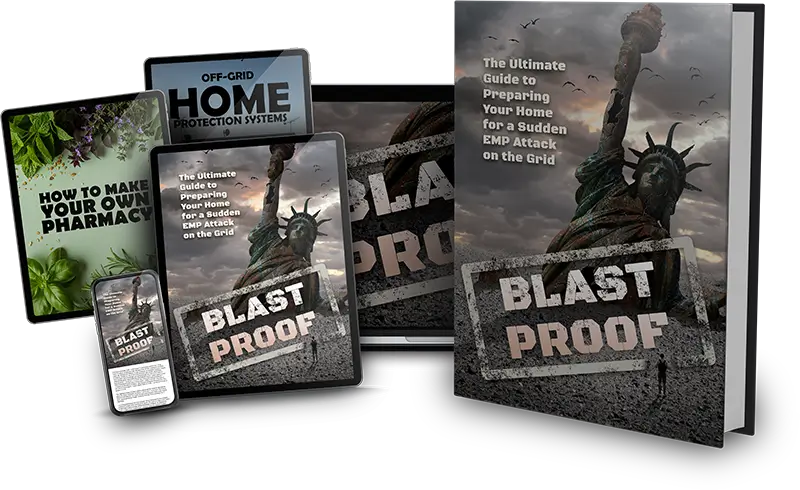
Introduction & What Is BlastProof: David's Shield?
BlastProof: David's Shield is a preparedness guide about protecting a household against an electromagnetic pulse (EMP) event and the long grid failure that could follow. It sells for $67 as a digital download, or $67 plus $11.95 shipping for a printed copy, and includes two bonus guides titled How To Make Your Own Pharmacy and Off-Grid Home Protection Systems.
The product is unusual among the ones we review because its packaging and its subject matter pull in opposite directions. The subject is legitimate: EMP and geomagnetic disturbance are recognized risk categories in US federal planning, with a dedicated program at the Cybersecurity and Infrastructure Security Agency and a congressional commission that assessed the threat. The packaging is a long sales video that frames an EMP strike as biblical prophecy in progress, identifies artificial intelligence as the Beast of Revelation, and tells the reader that the seals are opening and men of God must choose to fight or fade.
Those two things need to be held apart, and doing so is most of the work of this review. A real risk described in official documents does not become more likely because a sales page attaches scripture to it, and a guide does not become more useful because its marketing is frightening. The question that matters is narrower: at $67, does this deliver something a reader cannot get elsewhere, and is the seller transparent about what they are selling?
Below: what the product contains, what the documented risk actually looks like, what we could and could not verify about the publisher, the pricing and refund terms, and how the material compares to free federal guidance. Disclosure, as on every page of this site: we are independent reviewers, and purchases through our links may earn us a commission at no additional cost to you.
How Does It Work?
The product is information rather than equipment. The buyer receives a guide, delivered instantly in digital format, with an optional printed edition, plus two bonus guides. The sales page states no prior prepping experience is needed and describes the material as simple steps for ordinary families rather than off-grid specialists.
The stated scope is broader than its title suggests. The page's own FAQ says the guide is built around EMP survival but that its tools and systems apply to any long-term disaster: blackouts, cyberattacks, storms, economic collapse or civil unrest. That is a reasonable claim on its face, because the practical response to most extended grid failures overlaps heavily regardless of cause. Water, food, power, heat, medication, communication and a plan cover most of the ground whether the trigger is a hurricane or a solar storm.
It also means the marketing's central premise is doing less work than it appears to. If the preparations are essentially the same for a blizzard as for an EMP, then the EMP framing, and the prophecy framing wrapped around it, is not the substance of the product. It is the reason to buy it today rather than think about it. That is a marketing mechanism rather than a preparedness one, and it is worth naming plainly.
We should be equally plain about the limits of this review. We have not purchased and read the guide, so we cannot assess the quality, accuracy or originality of its contents. What follows evaluates the claims, the transparency and the commercial terms, which are what a prospective buyer can actually see before paying.
The Claims Against the Documented Risk
| What the sales page claims | What the documented record supports |
|---|---|
| An EMP could collapse the US grid | Recognized risk category. CISA runs a dedicated EMP and geomagnetic disturbance program, and a congressional commission assessed the threat. The concern is real and officially documented. |
| The grid is under-protected | Partially supported. The GAO has reported on federal actions and gaps in addressing electromagnetic risks, and grid hardening remains an open policy question. |
| A strike is imminent and already underway | Not supported. No published federal assessment states that an attack is in progress or forecasts a timeline. This is the sales page's assertion, not a finding. |
| A Chinese propaganda film reveals a battle plan | Not verifiable. The film is not identified, the intelligence contact is unnamed, and no part of this account can be checked by a reader. |
| AI is the Beast of Revelation and the seals are opening | Theological interpretation, not a factual claim. Readers may hold it as belief; it cannot support a product's efficacy and is not evidence of anything. |
| Written by Henry Morris, prepping author | Contradicted by the page's own fine print, which states that Henry Morris is a pen name. The FAQ separately credits "Charles" with designing the program. |
The first two rows are the reason this product is not simply dismissible. Grid vulnerability to electromagnetic events is a genuine subject of federal risk management, and a reader who becomes interested in household resilience because of it has not been misled about the category.
The bottom four rows are where the page stops describing a risk and starts manufacturing urgency. The distinction is not subtle. "CISA maintains an EMP program because the risk merits planning" and "the seals are opening, and the strike has already begun" are not two versions of the same statement. The first is a reason to spend a weekend on a household plan. The second is a reason to buy something in the next ten minutes, which is what it is designed to be.
What We Could and Could Not Verify
Several things on the sales page can be checked without buying anything, and they shape our rating more than the subject matter does.
The author is anonymous, and the page says so itself. The narrative is delivered by Henry Morris, who describes nearly two decades helping American families prepare and cites his work on Survivopedia and a book called Backyard Liberty. The fine print at the bottom of the same page states: "Henry Morris is a pen name. The author name used may be a pen name for storytelling and privacy purposes." A pen name is a legitimate choice in publishing. Presenting a résumé under it is a different matter, because the credentials offered as a reason to trust the guide belong to a person the reader cannot look up.
The page contradicts itself about authorship. The narrative is Henry's throughout. FAQ item two then says "Charles designed it for real families with real responsibilities." Nobody named Charles appears anywhere else on the page.
Four different retailers are named. The disclaimers state that ClickBank is the retailer of this product, that JVZoo serves as the retailer, that BuyGoods is the retailer, and that content is licensed by Digistore24. These cannot all be true of one checkout. This is the signature of a sales page assembled from a template, and it matters practically: the refund route depends on which retailer actually processes the payment.
Boilerplate from an unrelated product remains on the page. The FDA statement about diagnosing, treating, curing or preventing disease appears on a page selling a book about electromagnetic pulses. A promotional popup offers "2 Boxes for Only $49 Each" and recommends using David's Shield "for at least 2 months" to get lasting results. Boxes and months of use are supplement-funnel language. A book does not come in boxes and does not need a two-month course.
None of this proves the guide's contents are poor. It does establish that the page was built quickly from parts, which is relevant when the thing being sold is the seller's judgment and expertise.
Real User Benefits & Drawbacks
Pros
- The underlying topic is legitimate and recognized in federal risk planning, not invented for the sales page.
- Broad applicability by the seller's own account: preparations for EMP overlap with blackouts, storms and other extended outages, so the material may be useful regardless of the trigger.
- 60-day money-back guarantee, processed by a third-party retailer rather than at the seller's discretion.
- Instant digital delivery with an optional printed copy, which is a sensible format for material meant to be read when the power is out.
- Two bonus guides included at no additional cost.
Cons
- The author is a disclosed pen name presented with unverifiable credentials, and the page names a second, unexplained author.
- The urgency is manufactured: no federal assessment supports the claim that a strike is imminent or underway.
- Fear and faith are used as sales tools, which is a choice about the reader rather than about the subject.
- Four retailers named in the disclaimers and leftover supplement copy indicate a templated page.
- Substantial overlap with free federal guidance on preparedness, and the contents cannot be inspected before purchase.
Pricing, Packages & Refund Policy
The digital edition is listed at $67, including both bonus guides. The printed edition is listed at $67 plus $11.95 shipping and handling, with the same bonuses. The page notes that hard copies are not always in stock. A promotional popup offers a $29 price, which suggests the $67 figure is a starting point rather than a fixed one.
The stated refund policy is a 60-day money-back guarantee, described as no questions asked, with a full refund on request by email. Because a third-party retailer processes the payment, refunds generally run through that retailer's support rather than the vendor's goodwill. Given that the page names four possible retailers, note which one appears at checkout and keep that order confirmation email, since refunds are handled against the order number.
How It Compares to the Alternatives
Against free federal guidance: FEMA publishes household preparedness material at Ready.gov covering power outages, water and food storage, emergency kits and family communication plans, at no cost. CISA publishes free EMP protection and resilience guidelines. This is the direct comparison a $67 guide has to earn its way past, and a reader can review the free material first and decide afterward whether a paid guide adds anything.
Against established preparedness publishing: the subject has an extensive literature under named authors with checkable backgrounds, sold through ordinary bookstores at ordinary book prices. The relevant difference is not the price but the accountability: a named author with a verifiable record has something at stake in being wrong.
Against actually buying equipment: if the concern is a genuine extended outage, the constraint for most households is not knowledge but supplies. Water storage, a way to cook, a way to stay warm, a battery or generator, a stocked first aid kit and a month of essential medications are the things that matter when the power is off, and $67 spent on any of them is $67 spent on the actual problem.
Against the honest baseline: most people who buy a preparedness guide do not act on it. The marketing knows this, which is why it sells identity ("be the man God called you to be") rather than a checklist. A reader who wants to be prepared is better served by completing one free plan than by owning several unread guides. If the topic is of interest more broadly, our article on how to prepare for a long-term blackout covers the practical ground without the apocalypse attached.
What the Independent Record Actually Says
The risk is officially recognized. CISA maintains a public program page on electromagnetic pulse describing federal work on awareness, protection and recovery. This is the strongest support for the product's premise, and it is worth reading precisely because it is measured. It describes a risk to be managed, not an event in progress.
Grid protection has documented gaps. The Government Accountability Office's report on federal actions to address electromagnetic risks reviewed what agencies have done and where collaboration and risk assessment could be strengthened. It supports the general concern about preparedness while offering nothing resembling a forecast.
The free guidance is substantial. FEMA's power outages page covers what to do before, during and after an extended loss of power. It is short, practical and costs nothing, and it is the most direct comparison to what a paid guide on this subject offers.
The natural version of the threat is monitored publicly. Geomagnetic disturbances from solar activity can affect power systems, and NOAA's Space Weather Prediction Center publishes live forecasts and alerts. Anyone genuinely tracking this risk can watch it directly rather than through a sales page.
The commercial frame. Digital products of this kind are sold through third-party retailers whose role, as the disclaimers themselves state, does not constitute endorsement, approval or review of any claim made in the promotion. The refund policy is the buyer's real protection, and it is the reason the rating here is not lower.
Who This Is For, and Who Should Skip It
There is a real audience for household preparedness material, and their interest is rational. Extended outages happen. Hurricanes, ice storms and wildfires take power down for days to weeks in ordinary years, and the households that manage best are the ones that thought about water, heat and medication before they needed to. A reader who buys this guide, reads it, and ends up with a stocked kit and a family plan has come out ahead of where they started, whatever the quality of the prose that got them there.
But the marketing is not aimed at that reader. It is aimed at a specific person: an older Christian man who is worried about the country, feels that things are accelerating, and is being told that preparation is obedience and that hesitation is faithlessness. That is a precise piece of targeting, and it deserves to be named for what it does. It converts a practical decision, is a $67 guide worth it, into a test of character where declining reads as failing. Nobody makes a good purchasing decision under those conditions, which is the point of constructing them.
The people who should skip this are easier to identify. Anyone who has not yet read the free Ready.gov material should read that first, because it costs nothing and covers the fundamentals, and because it provides the baseline against which any paid guide can be judged. Anyone who wants verifiable expertise should note that the author is a disclosed pen name with unverifiable credentials and that a second author appears without explanation. And anyone who finds the video's use of scripture persuasive should consider that persuasion, rather than information, is what it was engineered to do. Fear is an effective sales tool, and its effectiveness has no relationship to whether the underlying product is any good.
One practical note for the genuinely concerned reader. If the EMP scenario specifically is what worries you, the useful actions are concrete and mostly cheap: keep a battery radio and spare batteries in a shielded container, keep printed copies of important documents and contact numbers, keep a supply of any critical medication, know how to shut off your utilities, and have a family meeting point. None of that requires a purchase or a prophecy.
Frequently Asked Questions
What is BlastProof: David's Shield?
A preparedness guide about protecting a home against an EMP event and extended grid failure, sold as a $67 digital download or a printed copy at $67 plus $11.95 shipping, with two bonus guides included.
Is the EMP threat it describes real?
The risk category is recognized: CISA runs an EMP and geomagnetic disturbance program and a congressional commission assessed the threat. What is not supported is the page's claim that a strike is imminent or already underway. Documented risk and apocalyptic certainty are different things.
Who actually wrote it?
The page attributes it to Henry Morris and then states in its own fine print that Henry Morris is a pen name. Its FAQ separately credits the design to "Charles". No verifiable author is disclosed, so the credentials given cannot be checked.
Is the information available for free?
Much of the subject matter is published free by FEMA at Ready.gov, and CISA publishes free EMP protection guidelines. We have not read the book, so we cannot say how much of its content is unique.
What is the refund policy?
A stated 60-day money-back guarantee processed by a third-party retailer. The page names four different retailers in its disclaimers, so check which one appears at checkout and keep that confirmation email.
Final Verdict: Is David's Shield a Scam or Legit?
David's Shield is a real product. A buyer receives a guide, checkout runs through an established third-party retailer, and the 60-day refund route does not depend on the seller's cooperation. On a definition of scam that means "takes your money and sends nothing", this does not qualify, and the refund window is genuine protection.
What we can evaluate, though, is not encouraging. The author is a pen name, disclosed as such by the seller, presented with a résumé the reader cannot verify, and a second author appears in the FAQ without explanation. The page names four incompatible retailers and still carries an FDA disclaimer and a popup selling boxes of something by the month, which tells you the page was assembled from a template rather than written by an expert. The urgency that drives the entire pitch, that the strike has begun and the seals are opening, appears in no federal assessment and cannot be checked by anyone. And the underlying subject, which is legitimate and officially documented, is covered for free by FEMA and CISA.
The honest summary is that the topic is real and this particular treatment of it is unverifiable. A reader interested in household resilience can get the fundamentals free at Ready.gov, watch the actual space weather forecasts at NOAA, read CISA's own guidelines, and spend the $67 on water storage or a month of medication instead. If they still want this guide afterward, the 60-day window means they can read it and decide. What should not drive that decision is the feeling the video was built to produce.
Our rating: 3.7/5. This sits at the top of our floor band (see how we rate), because presenting a résumé under a name the seller admits is fictional is a false claim rather than ordinary hype. It is not at the bottom of that band: a preparedness book carries no health risk and does not steer anyone away from care. Credited for a legitimate underlying subject, a real refund route through a third-party retailer, and a sensible format. Docked for an anonymous author presented with unverifiable credentials, a contradicted authorship claim, a templated page carrying four retailers and unrelated boilerplate, urgency claims supported by nothing, and substantial overlap with free federal guidance.