
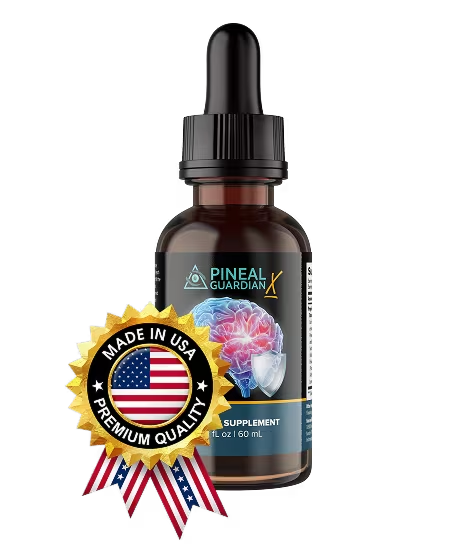
Introduction & What Is Pineal Guardian?
Few supplements lead with an organ most buyers could not place on a diagram. Pineal Guardian does: its entire marketing story revolves around the pineal gland, a pea-sized structure deep in the brain, and its claimed role in memory, clarity and "brain aging." The product itself is a liquid formula taken as a daily dropper, combining pine bark extract, tamarind, bacopa monnieri, ginkgo biloba, chlorella and spirulina.
That framing needs sorting on page one. The pineal gland's established job is producing melatonin, the hormone that times sleep and wake. It is real, it does calcify with age in many people, and sleep genuinely matters for memory. What is not established is any clinical evidence that a supplement can "decalcify" the gland, restore its function, or that doing so would improve memory. Pineal Guardian's ingredients are better understood as a fairly conventional botanical-and-algae brain formula wearing an unusually specific anatomical story.
The product targets adults, mostly 50 and older, worried about word-finding, forgetfulness and mental sharpness. The manufacturer positions it as daily nutritional support for brain health, not as a treatment for memory disorders, and we will keep that boundary explicit throughout, because in the memory category the stakes of blurring it are high.
Below: the full ingredient analysis, what the pineal story gets right and wrong, honest pros and cons, pricing with the 180-day refund terms, and a realistic timeline. Disclosure, as on every page of this site: we are independent reviewers, and purchases through our links may earn us a commission at no additional cost to you.
How Does It Work?
Strip away the pineal narrative and the formula makes three recognizable bets. The first is circulation and antioxidant support: pine bark extract (a proanthocyanidin source) and ginkgo biloba both appear in research on blood flow and oxidative stress, on the logic that brain tissue depends on perfusion. The second is traditional cognitive botanicals: bacopa monnieri is one of the most-studied herbs in memory research, with several small trials suggesting modest effects on recall after 8 to 12 weeks. The third is nutrient-dense algae: chlorella and spirulina contribute micronutrients and are studied mostly for general nutritional and antioxidant properties rather than cognition specifically.
The liquid format is a practical point: droppers suit people tired of pills, and dosing can be taken in water or coffee. Absorption claims for liquid formulas versus capsules, however, are marketing shorthand; meaningful bioavailability differences depend on the specific compound and are rarely documented for blends like this.
The honest scientific picture: bacopa and ginkgo have genuine but mixed human research, individually, at studied doses, over months. Pine bark extract has small trials in circulation and, less robustly, cognition. The complete Pineal Guardian formula has no independent clinical trials, and nothing in the published literature connects any of these ingredients to the pineal gland specifically. Memory complaints also have medical causes, thyroid, B12, medications, depression, sleep disorders, that a supplement cannot address and a doctor can. Evaluation comes first.
Core Ingredients Analysis
| Ingredient | What the manufacturer includes it for | Evidence snapshot |
|---|---|---|
| Pine bark extract | Antioxidant and circulation support for brain tissue. | Small trials on blood flow and oxidative markers; early, limited cognition data. |
| Bacopa monnieri | The formula's main memory botanical. | Multiple small randomized trials suggest modest recall improvements over 8–12 weeks; effects are gradual and not universal. |
| Ginkgo biloba | Classic circulation-and-cognition herb. | Extensively studied; large trials failed to show dementia prevention, smaller ones show mixed cognitive effects. |
| Tamarind | Traditional plant included around the product's "cleansing" story. | Studied for fluoride excretion in small studies; no cognitive outcome data. |
| Chlorella | Nutrient-dense green algae. | General nutrition and antioxidant research; cognition-specific evidence minimal. |
| Spirulina | Blue-green algae for micronutrient support. | Reasonable nutritional profile; human cognitive trials are scarce and preliminary. |
What stands out positively: the ingredients are named, familiar and researchable, and bacopa in particular is a defensible inclusion in any memory-support formula. Nothing here is pharmacologically exotic.
What deserves scrutiny: per-ingredient doses are not disclosed in marketing materials, which matters enormously for bacopa and ginkgo, whose studied effects are dose-dependent. The tamarind-and-algae "cleansing" portion is connected to the pineal story by narrative, not by clinical data. And the pineal framing itself oversells what any of these compounds are documented to do.
Safety notes: ginkgo has blood-thinning properties and interacts with anticoagulants; bacopa can cause digestive upset; algae products vary in quality control. Anyone on medication, and anyone whose memory changes are recent or worsening, should see a doctor before considering supplements, both for interactions and because memory symptoms deserve diagnosis, not masking. For a broader look at everyday forgetfulness and when it matters, see our article on why you might be so forgetful lately.
Real User Benefits & Drawbacks
Pros
- Bacopa and ginkgo are legitimate, much-studied cognitive botanicals, the formula's core is not invented.
- Liquid dropper format suits people who dislike pills and allows flexible dosing in drinks.
- 180-day money-back guarantee, among the longest windows in the category, processed through ClickBank.
- Named ingredients rather than an opaque proprietary blend.
Cons
- The pineal-gland story outruns the evidence: no clinical data connects these ingredients to pineal function or "decalcification."
- No independent trials of the finished formula; ingredient evidence is mixed and dose-dependent.
- Doses are not disclosed in marketing materials, making comparisons with studied amounts impossible before purchase.
- Memory symptoms can have medical causes that need a doctor, not drops.
Pricing, Packages & Refund Policy
Pineal Guardian is sold in single, 3-bottle and 6-bottle packages through the official website only. At the time of writing, a single bottle (a 30-day supply) is listed at a promotional price of around $69 against a stated regular price of $99, with bundles bringing the per-bottle price to roughly $59 (three bottles) and $39–$49 (six bottles), plus shipping that varies by package. Treat these as a snapshot and confirm live pricing on the official page.
For scale: bacopa's positive trials generally ran 8 to 12 weeks, meaning two to three bottles cover the window where the best-studied ingredient was tested.
The stated refund policy is a 180-day money-back guarantee on every package bought through the official website, processed through ClickBank's standard retail support. Keep the order confirmation email.
How It Compares to the Alternatives
Against single-ingredient bacopa or ginkgo: both are available as standardized single supplements at documented doses for a fraction of the price. The blend's case is convenience and breadth; the single-ingredient case is knowing exactly what dose you are taking of the only components with meaningful cognitive research.
Against sleep improvement directly: if the appeal of the pineal story is really about sleep and its effect on memory, the interventions with actual evidence are unglamorous: consistent schedules, morning light, limiting evening alcohol and screens, and treating sleep apnea where present. All of them cost little or nothing.
Against other memory-support products: the category, including audio-based programs and other botanical blends, shares the same structural weakness: plausible components, no product-level trials. Our review of The Memory Wave covers the audio-program side of that shelf for comparison.
Against medical evaluation: for memory changes that worry you or others around you, a physician's workup (medications, B12, thyroid, mood, sleep disorders) has diagnostic power no supplement offers, and several of those causes are treatable.
What the Independent Research Actually Says
Start with the gland itself. The pineal gland's established role is melatonin production and sleep-wake timing; the NIH's neurological institute maintains an accessible primer on the brain and sleep. Sleep quality genuinely relates to memory consolidation, which is the defensible kernel inside this product's story.
Bacopa's record. The most relevant ingredient has real randomized trials, small, weeks-long, with modest recall effects; this PubMed search on bacopa and memory shows both the signal and its limits.
Ginkgo's cautionary arc. After decades of popularity, the large GEM trial found ginkgo did not prevent dementia; the NIH's complementary-health center summarizes the state of play on its ginkgo page. Smaller cognitive findings remain mixed.
Melatonin, since the story invokes it. The same center's melatonin overview is the sober reference: useful in specific sleep-timing situations, not a memory treatment.
The regulatory frame. Like all supplements, Pineal Guardian is regulated as food under the FDA's dietary supplement framework, with no pre-market efficacy review, which is why the refund window weighs heavily in our verdict.
The wider context. Deep sleep genuinely declines with age, and the pineal story is built on top of that real change. Our guide to sleep and the aging brain covers what shifts in sleep architecture, what melatonin does and does not do, and which interventions have evidence behind them.
What to Expect: A Realistic Timeline
- Weeks 1–2: No measurable memory change should be expected from any ingredient here this fast; distrust products or testimonials that claim otherwise.
- Weeks 3–8: The earliest window where bacopa trials began registering effects. If you want a fair self-test, pick something countable, names recalled from a news article, items from a list, and note results weekly.
- Weeks 9–16: Fair-verdict territory for the formula's best-studied components. If your tracked results have not moved, the product is not moving them; the 180-day window still leaves room for a refund decision made on evidence.
Throughout: treat new, worsening or life-disrupting memory problems as a medical matter first. A supplement is never the correct response to symptoms that worry you or your family.
Who the Evidence Applies To, and Who Should Avoid It
The bacopa trials that give this formula its most defensible ingredient were conducted mostly in healthy adults, frequently older ones, without diagnosed cognitive impairment, over 8 to 12 weeks, using standardized extracts at specified doses. That is the population the evidence describes: people with ordinary age-related forgetfulness, not people with a dementia diagnosis or a rapidly changing memory. For the latter group, the research offers nothing, and the risk of a supplement postponing a diagnostic workup is not theoretical.
The ginkgo literature carries a similar boundary in a more pointed form. The largest, longest trial ever run on it, following thousands of older adults for years, was designed to answer whether ginkgo prevents dementia. It did not. Smaller trials on ordinary cognitive performance remain mixed. So a reader hoping this formula addresses a genuine fear of dementia is hoping for something the best-powered study in the field specifically failed to find.
Several groups should avoid this product or clear it with a physician first. Ginkgo's antiplatelet properties make it a real concern for anyone on warfarin, direct oral anticoagulants, or even regular aspirin, and for anyone scheduled for surgery or a dental procedure, where it is commonly recommended to stop such supplements well in advance. Bacopa can cause meaningful gastrointestinal upset, and it has cholinergic activity that deserves a doctor's input for anyone on medications acting through that system. Algae products, chlorella and spirulina here, vary widely in sourcing quality and can concentrate contaminants when poorly produced, which matters more for a product whose story is about avoiding toxins.
There is a final group worth naming: people whose real problem is sleep. If the appeal of this product is its pineal-and-melatonin framing, and if the underlying experience is broken nights, early waking or snoring that a partner has noticed, then the useful path is a sleep evaluation, not drops. Sleep apnea is common, underdiagnosed, genuinely linked to cognitive complaints, and treatable. That is a diagnosis worth having rather than working around.
Frequently Asked Questions
What is Pineal Guardian?
A liquid dietary supplement taken as daily drops, marketed for memory support and brain health with heavy emphasis on the pineal gland. It combines pine bark extract, tamarind, bacopa, ginkgo, chlorella and spirulina. It is not a medication.
Does Pineal Guardian work for memory?
Bacopa and ginkgo have been studied for cognition with mixed results at specific doses. The finished formula has no independent trials, so the available evidence is insufficient to conclude it improves memory.
What does the pineal gland actually do?
Its established function is producing melatonin, which times sleep and wake. Claims that supplements can decalcify or supercharge it are not supported by clinical evidence.
How do you take it?
One full dropper daily, directly or in water or another beverage, per the manufacturer, with consistency over weeks emphasized.
Where is it sold and what is the refund policy?
Only through the official website, with ClickBank checkout and a stated 180-day money-back guarantee processed through ClickBank's retail support.
Final Verdict: Is Pineal Guardian a Scam or Legit?
Structurally, Pineal Guardian is a legitimate retail product: named ingredients, ClickBank checkout, and a 180-day refund route independent of the vendor. Its core botanicals, bacopa and ginkgo, are exactly what a memory formula assembled from the published literature would contain, and the refund window is one of the most generous we have seen in this category.
The marketing is another matter. The pineal-gland narrative dresses a conventional botanical blend in anatomical specificity the evidence does not support, and the absence of disclosed doses makes even the defensible ingredients impossible to evaluate against their studies before purchase. The sequence the evidence does support: a doctor's evaluation for any concerning memory change; sleep, activity and cardiovascular health next, the levers with real data; and only then, optionally, a formula like this as an unproven addition judged by results you actually count.
Our rating: 3.9/5. Credited for legitimate core botanicals and an industry-leading guarantee; docked for a story that outruns its science, undisclosed dosing, and no product-level trials.