
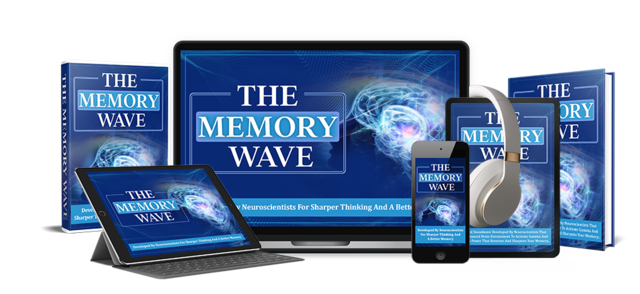
Introduction & What Is The Memory Wave?
The Memory Wave belongs to a category most shoppers have never consciously browsed but have almost certainly brushed against on YouTube: brainwave audio. It is a digital program, no pills, no devices, no equipment beyond something that plays sound, built around engineered audio tracks that, according to the makers at Binaural Technologies, help nudge the brain toward the activity patterns associated with memory and mental sharpness. You listen for a few minutes a day, ideally with headphones, and let the layered frequencies do their work.
The product targets a real and widely felt worry: names that slip away mid-sentence, the reason you walked into a room evaporating, the general sense of mental fog that creeps in with age, stress, and chronic screen-life. Its pitch is disarmingly simple, press play daily, and its price is modest by the standards of the "brain" market: a one-time purchase of around $39 with no subscription.
This review lays out what you actually receive, how the claimed mechanism works and what independent science says about it, the honest pros and cons of an audio-only product, complete pricing and refund details, and the questions buyers ask most. Our standing disclosure applies: this is an independent review page, we are not the product's creators, and purchases through our links may earn us a commission at no extra cost to you.
How Does It Work?
The mechanism The Memory Wave leans on is called brainwave entrainment. The premise: the brain's electrical activity oscillates in measurable rhythms, delta in deep sleep, alpha in relaxed wakefulness, and so on, and rhythmic external stimulation, including sound, can encourage brain activity to synchronize toward a target frequency. Binaural beats, isochronic tones, and layered soundscapes are the standard tools of the trade. The Memory Wave's sessions are engineered around frequencies the makers associate with memory-relevant brain states; the daily listening routine exists because entrainment effects, where they occur, are transient and respond to repetition.
What does independent science say? Entrainment itself is a real, measurable phenomenon, EEG studies do show brain activity responding to rhythmic auditory stimulation. Where the literature gets genuinely mixed is the step this product's marketing cares about: whether short daily entrainment sessions translate into meaningful, lasting improvements in everyday memory. Some small studies report gains in attention, relaxation, or specific memory tasks; others find little beyond the (real and useful) effects of sitting quietly with calming audio. There is no large, definitive trial behind this category, and any honest review has to say so.
Our framing for a fair purchase decision: the floor is solid, the ceiling is uncertain. The floor, a few minutes of engineered, relaxing audio daily, is a genuinely pleasant ritual, and relaxation itself supports attention and recall. The ceiling, measurable memory enhancement from the specific frequencies, has not been established by independent research, and the available evidence cannot predict it for any individual.
Core Features Analysis
| Feature | What you get | Why it matters |
|---|---|---|
| Engineered audio sessions | The core Memory Wave tracks, built from layered soundwave frequencies targeting memory-associated brain states. | This is the product; everything else is delivery detail. |
| Short daily protocol | A listening routine measured in minutes per day. | Low time cost is the difference between a habit and an abandoned purchase. |
| Instant digital access | Stream or download on phone, tablet, or computer immediately after purchase. | No shipping, no physical product, works on anything with audio output. |
| One-time pricing | A single payment of about $39, no subscription, no recurring billing. | Rare in an industry that increasingly defaults to monthly charges. |
| 90-day ClickBank guarantee | Refund window processed by the retailer, not the vendor. | Refund requests go through the retailer's standard channel. |
A note on what is not in the box: there are no ingredients, which means no interactions, no allergens, and none of the safety diligence a supplement demands. The practical requirements are exactly two, a quiet stretch of minutes and, ideally, headphones, since layered-frequency audio of this kind depends on stereo separation to deliver what was engineered.
Who It Fits, and Who It Doesn't
The natural fit for a product like this is someone who already suspects they would benefit from a daily decompression ritual and likes the idea of anchoring it to a purpose: the retiree who wants a gentle daily practice for staying mentally engaged, the over-stressed professional whose "memory problems" are really attention problems caused by overload, the student who studies better after a few minutes of deliberate calm. For all three, what the product most plausibly provides is a structured relaxation habit; anything beyond that is unestablished.
The poor fit is equally clear. If you are worried about genuine, progressive memory decline, in yourself or a family member, an audio program is not the appropriate response; that conversation belongs with a physician, and no consumer product should delay it. And if you know yourself well enough to predict you will not actually listen daily, save the money: an unused audio file delivers exactly nothing, guarantee or not.
How to Evaluate It Honestly
Because results are subjective, the only trustworthy evaluation is a structured one: pick a fixed time slot, listen with headphones every day for thirty days, and keep a two-line daily note, one line for focus, one for recall moments. At day thirty, read the notes back. A real effect shows up as a pattern you can point to; a placebo glow rarely survives four weeks of written records. Whatever the notes show is the evidence worth trusting.
Real User Benefits & Drawbacks
Pros
- Very low effort: minutes of passive listening per day, no learning curve, no lifestyle overhaul.
- One-time $39 price with no subscription, cheap by "brain training" market standards.
- Instant delivery on any device; nothing to ship, nothing to install beyond an audio player.
- Zero ingestion risk: an audio product carries none of a supplement's interaction concerns.
- 90-day money-back guarantee handled through ClickBank's standard retail refund process.
Cons
- Mixed independent evidence that entrainment audio improves everyday memory beyond relaxation effects.
- Entirely subjective results, some listeners feel sharper, others feel nothing distinct.
- Digital-only: nothing physical arrives, which some buyers still find uncomfortable at purchase.
- Consistency-dependent: sporadic listening almost certainly does nothing; the habit is the product.
Pricing, Packages & Refund Policy
The Memory Wave is sold as a single digital package at a one-time promotional price of about $39, against a stated regular value of $97. There are no tiers to compare and no subscription lurking behind the checkout, one payment, instant access. Order-page upsells may be offered after purchase, as is standard for ClickBank digital products; none are required for the core program to function.
The stated refund policy is a 90-day money-back guarantee processed through ClickBank rather than the vendor. Keep your ClickBank order confirmation email; requests go through the retailer's standard support channel.
How It Compares to the Alternatives
Against free brainwave audio: YouTube and streaming platforms carry endless "memory frequency" tracks at zero cost. The honest differences: engineered session structure with a defined start and end, no ads interrupting an entrainment session (a real mechanism problem with free platforms), and offline downloads. Whether a paid commitment helps a habit stick is a behavioral hypothesis, not a measured effect. If free tracks have already become a durable habit for you, they cover similar ground.
Against meditation apps: subscription apps ($60–$100/year, forever) offer guided practice with a much deeper evidence base for stress and attention. If you enjoy voice guidance and structure, their evidence base is deeper; if you specifically want short, wordless, put-it-on-and-close-your-eyes sessions, The Memory Wave's one-time price is lower than a subscription over horizons beyond six months.
Against its own siblings: within the same product family, The Brain Song and The Genius Song aim at focus and mental sharpness rather than memory. Pick by your actual complaint, we compare the family directly in The Genius Song vs The Brain Song.
Against the well-supported free levers: sleep, exercise, cardiovascular health, and social engagement have far stronger evidence behind them than any product in this paragraph, at zero dollars. Any audio purchase should be understood as an addition to that list, never a substitute for it.
What the Independent Research Actually Says
Brainwave audio is a field where marketing loves to sprint ahead of the evidence, so here is the sober version, with sources you can verify.
On binaural beats and cognition. The academic literature on auditory entrainment and mental performance is genuinely two-sided: some controlled studies report measurable effects on attention, working memory, or anxiety; others find nothing beyond relaxation. Browse the current literature yourself in this PubMed search on binaural beats and cognition, you will notice the studies are small, short, and inconsistent in methodology, which is exactly why no serious reviewer promises results from this category.
On what audio demonstrably does. The Sleep Foundation's evidence review of binaural beats lands where most careful readers do: the strongest signals are for relaxation and pre-sleep wind-down rather than raw cognitive enhancement. Since stress and poor sleep are two of the best-documented enemies of everyday memory, a daily relaxation ritual could in principle help indirectly, but that is a biological hypothesis, not a demonstrated effect of this product.
On memory concerns themselves. If the reason you are shopping is that lapses have become frequent or worrying, start with the National Institute on Aging's guide to memory loss and forgetfulness, which explains the wide normal range of age-related change and the specific signs that deserve a doctor's evaluation. MedlinePlus also keeps a plain-English hub on memory covering the well-supported basics: sleep, physical activity, cardiovascular health, and social engagement move the needle more reliably than any audio track.
Where does that leave The Memory Wave? As an inexpensive daily audio ritual that involves no ingestion, whose most defensible outcome is a few calm minutes, and whose claimed cognitive benefit remains scientifically unsettled. The available evidence is insufficient to conclude whether the memory claim holds; miracle expectations have no support at all.
What to Expect: A Realistic Timeline
- Days 1–7: What you can fairly judge immediately: do you find the sessions pleasant, and do they fit your day? A program you dislike will not survive week three, whatever its frequencies do.
- Weeks 2–4: The window where relaxation-related changes typically surface, falling into the session faster, feeling noticeably calmer afterward. Some users report better wind-down before sleep here.
- Weeks 5–8: The fair test for the memory claim itself. Use concrete markers, not vibes: names recalled at the moment needed, fewer walk-into-the-room blanks, less re-reading of the same paragraph.
- Beyond week 8: a program that has produced no change in your tracked markers by now is unlikely to do so later. Judge on the markers you wrote down, not on general impressions.
For a deeper skeptical dive into the central question, read our companion article: Does The Memory Wave really work?
Frequently Asked Questions
Does The Memory Wave really work?
Brainwave entrainment is a real research area, but the evidence that short daily audio sessions improve everyday memory is mixed, there is no independent research on this specific program, and individual experiences vary widely. Some users find the sessions relaxing and report feeling sharper; others notice little.
Is The Memory Wave legitimate?
It is a real digital product sold through ClickBank, a long-established retailer, with a stated 90-day refund policy processed by ClickBank itself. Being a real product is a separate question from whether its memory claims are supported; the evidence for those remains mixed.
How long are the sessions?
Short, minutes per day. The makers recommend daily listening, ideally with headphones, for consistent exposure.
Is it a pill or supplement?
No. The Memory Wave is entirely audio-based. Nothing is ingested, so there are no ingredient interactions to consider.
Can I use it alongside other memory habits?
Yes, and you should. Sleep, exercise, and mental engagement remain the foundations of memory. Treat the program as a complement, never a replacement.
Final Verdict: Is The Memory Wave Legit and Worth It?
The Memory Wave is a legitimate digital product in the structural sense: $39 once, minutes a day, nothing ingested, and a stated 90-day retailer-processed refund window. The structure of the offer, one-time price, retailer-processed refunds, no subscription, is transparent by the standards of digital wellness products.
The candid assessment of the substance: the science floor under audio entrainment is real but thin, the memory-enhancement ceiling claimed by the marketing has not been established by independent research, and personal results land somewhere between "pleasant daily relaxation ritual" and "noticeably sharper" in a way the current evidence cannot predict. Anyone evaluating it should rely on written daily notes rather than impressions, and anyone with genuine memory concerns should start with a physician, not an audio file.
Our rating: 4.1/5. Low cost, minimal effort, and a transparent offer structure; docked for the mixed independent evidence and the inherently subjective, unpredictable results.