
Introduction & What Is Audifort?
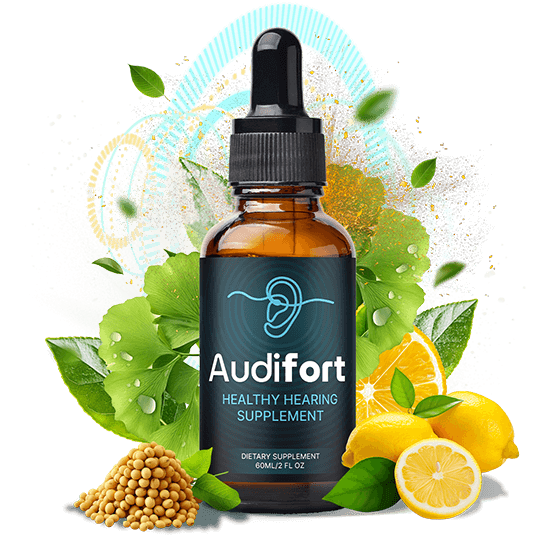
Audifort is a liquid dietary supplement taken by dropper and sold as a hearing support formula. The manufacturer states it contains more than 20 ingredients, of which six are named publicly: maca root, grape seed, green tea, capsicum annuum, gymnema sylvestre and GABA. It is aimed largely at older adults, and the marketing sits close to two of the most common complaints in that group: hearing that is fading and ears that ring.
Those two complaints deserve to be separated from the product before anything else, because they are medical conditions with identifiable causes. Age-related hearing loss usually reflects damage to the hair cells of the inner ear, which do not regenerate in humans. Tinnitus is a symptom rather than a disease, and its causes range from noise exposure and earwax impaction to medication effects and, less commonly, treatable conditions that an examination can find. Neither is a nutrient deficiency in the ordinary case, and that framing matters for every claim that follows.
What sets Audifort apart from most products we review is not its ingredient list but what it withholds. The formula is a proprietary blend: the ingredients are partially named, and the amount of each is not disclosed. Fourteen or more of the stated ingredients are not named at all. That single fact constrains how far any honest analysis can go, and we treat it as the central issue rather than a footnote.
Below: the proposed mechanism, what the research says about the named ingredients, pros and cons, the pricing and refund terms, and a realistic account of what the evidence does and does not support. Disclosure, as on every page of this site: we are independent reviewers, and purchases through our links may earn us a commission at no additional cost to you.
How Does It Work?
The marketing proposes a mechanism in three parts, and each is best labeled for what it is.
The first is circulation to the inner ear. The cochlea is supplied by a single, small artery with no meaningful collateral supply, so the hypothesis that blood flow influences hearing is biologically reasonable and appears in the medical literature. Grape seed extract, green tea and capsicum are the ingredients that carry this idea in the formula. What the reasoning does not establish is a clinical result: a plausible mechanism is a hypothesis, not a demonstrated effect, and no trial has shown that this formula changes cochlear perfusion or hearing thresholds.
The second is antioxidant protection of the hair cells. Oxidative stress is genuinely studied as a contributor to noise-induced and age-related hearing damage, and it remains an active research field. Grape seed proanthocyanidins and green tea catechins are studied antioxidants. The gap here is the same one that recurs across this category: most of the hearing-specific work is laboratory or animal research, generally using isolated compounds at controlled doses, and it has not translated into a supplement that preserves human hearing.
The third is calming the nervous system, carried by GABA, the brain's main inhibitory neurotransmitter. There is a real observation underneath it: tinnitus distress is closely tied to attention and stress, which is why the interventions with the strongest evidence for tinnitus are behavioral rather than pharmacological. The problem is pharmacological. Oral GABA crosses the blood-brain barrier poorly, and whether supplemental GABA reaches the central nervous system in meaningful amounts remains disputed in the literature.
Taken together: the mechanisms are proposed rather than demonstrated, they rest on ingredient-level and often preclinical research rather than on the finished product, and the doses that would determine whether any of that research is even relevant here are not disclosed.
Core Ingredients Analysis
| Ingredient | What the manufacturer includes it for | Evidence snapshot |
|---|---|---|
| Maca root | Energy and general vitality. | Small trials look at energy, mood and sexual function. No hearing outcome research. |
| Grape seed extract | Antioxidant and circulation support. | Studied antioxidant; some blood pressure work. Hearing evidence is largely animal and lab based. |
| Green tea | Antioxidant, alertness. | Extensively studied for metabolic and cardiovascular markers. No established hearing benefit. |
| Capsicum annuum | Circulation, thermogenesis. | Some metabolic and circulatory research; results inconsistent. No hearing outcome data. |
| Gymnema sylvestre | Present in the blend without a stated hearing rationale. | Studied mainly for blood sugar markers. No plausible or tested link to hearing. |
| GABA | Relaxation, tinnitus distress. | Central inhibitory neurotransmitter; oral supplementation's ability to reach the brain remains disputed. |
| 14+ undisclosed ingredients | Not named publicly. | Cannot be evaluated. This is the majority of the stated formula. |
Two observations follow from that table, and they are the heart of this review.
The first is that not one of the six named ingredients has clinical evidence for hearing outcomes in humans. Some have research in other domains, and grape seed and green tea have genuine antioxidant credentials, but the specific claim the product is sold on has no ingredient-level support behind it. Gymnema sylvestre is the clearest illustration: it is a blood sugar botanical with no proposed connection to the ear at all.
The second is that the proprietary blend removes the possibility of checking. Botanical effects are dose-dependent, which is the entire lesson of the ginkgo tinnitus literature, where trials used standardized extracts at specified doses and still found nothing. When a label does not say how much of anything is present, a reader cannot compare the product against any study, and neither can we. Whether the named ingredients appear at researched levels or as a few milligrams for the label is unknowable from outside.
Safety notes: green tea extract has been associated with liver injury in rare cases, particularly in concentrated form, and the NIH's complementary health center documents this. Gymnema can lower blood sugar and warrants care in anyone on diabetes medication. Capsicum commonly causes digestive upset. Because 14 or more ingredients are undisclosed, interaction checking is not fully possible, which is a genuine concern for older adults on multiple prescriptions. Anyone taking medication should speak to a doctor or pharmacist before starting.
Real User Benefits & Drawbacks
Pros
- Liquid dropper format suits people who have difficulty swallowing capsules, which is a practical consideration in the target age group.
- 90-day money-back guarantee processed through ClickBank rather than the vendor directly, so the refund route does not depend on the seller's goodwill.
- Two ingredients with legitimate antioxidant research (grape seed, green tea), even if that research has not produced hearing outcomes.
- Established retail infrastructure: standard checkout, stated shipping terms and documented customer service, which distinguishes it from anonymous storefronts.
Cons
- Proprietary blend with undisclosed doses, which makes it impossible to compare the formula against any research before buying.
- Most of the formula is not even named: six ingredients disclosed out of a stated 20-plus.
- No named ingredient has clinical hearing evidence in humans, and at least one (gymnema) has no proposed connection to hearing at all.
- No independent trials of the finished product.
- Hearing loss and tinnitus need medical evaluation; some causes are treatable, and a supplement can delay finding them.
Pricing, Packages & Refund Policy
Audifort is sold through the official website only, in single-bottle and bundle packages. At the time of writing, a single bottle (a 30-day supply) is listed near $69 plus shipping, with the 3-bottle package around $59 per bottle and the 6-bottle package around $49 per bottle. The larger bundles are stated to include free US shipping and two digital bonus guides. ClickBank offers change frequently, so confirm live pricing on the official page.
The stated refund policy is a 90-day money-back guarantee on purchases through the official website, processed through ClickBank's standard retail support. Published terms state that refunds cover the product price and exclude shipping and handling fees. Keep the order confirmation email, since ClickBank refunds are handled against the order number rather than the vendor.
One arithmetic note belongs here as a neutral fact rather than a nudge in either direction: the marketing directs two droppers daily, which is a faster consumption rate than a once-daily product, so a bottle described as a 30-day supply is a 30-day supply at that stated dose.
How It Compares to the Alternatives
Against a hearing evaluation: an audiologist can measure hearing thresholds, identify conductive causes such as earwax impaction or middle ear fluid, and detect the asymmetries that require further investigation. Several causes of hearing difficulty are correctable, and none of them are found by a supplement. For anyone with a genuine hearing complaint, this is the step with actual diagnostic power.
Against hearing aids: for age-related hearing loss, amplification is the established standard of care, and over-the-counter hearing aids have been available in the United States since the FDA's 2022 rule, which substantially changed the cost picture. No supplement has demonstrated anything comparable, and the comparison is not close.
Against the tinnitus evidence: for tinnitus specifically, the interventions with the strongest support are behavioral. Cognitive behavioral therapy has the most consistent evidence for reducing tinnitus distress, and sound therapy is widely used. Clinical guidelines are explicit that dietary supplements are not recommended for persistent tinnitus, a position based on trials of ginkgo, zinc and others that did not establish benefit.
Against other supplements in this category: the hearing supplement shelf is crowded with liquid dropper formulas telling similar stories. What distinguishes Audifort within that group is unfavorable: many competitors at least disclose their doses. A formula that names its amounts can be checked against the literature, and that possibility is worth more than any narrative.
What the Independent Research Actually Says
The ginkgo lesson. The most-studied botanical for tinnitus is not in this formula, and its research history is the reason this category invites caution. A 2022 Cochrane review of ginkgo biloba for tinnitus pooled 12 randomized studies in 1,915 participants and concluded that ginkgo may have little to no effect on tinnitus severity compared with placebo, while rating the certainty of that evidence as very low. The point worth carrying is not that ginkgo was disproven; it is that the ingredient with the best-designed trials in this space, tested at standardized and disclosed doses, has still not produced a clear answer after 12 studies.
What clinical guidelines say about supplements. The American Academy of Otolaryngology's clinical practice guideline on tinnitus recommends against dietary supplements for persistent tinnitus, a position reflected in the NIDCD's tinnitus overview. This is a recommendation against, not an absence of a recommendation, and the distinction matters.
Hearing loss is structural. The NIH's aging institute's page on hearing loss in older adults describes the mechanism plainly: hair cell damage in the inner ear, which does not regenerate. Nutritional supplementation has not been shown to reverse it, and the biology explains why that would be a difficult claim to support.
The antioxidant hypothesis, fairly stated. Oxidative stress in hearing damage is a real and active research field; this PubMed search on antioxidants and hearing loss shows both the volume of interest and the current limits, which are that human trial results remain preliminary and inconsistent.
The regulatory frame. Audifort is regulated as food under the FDA's dietary supplement framework. There is no pre-market review of efficacy, and proprietary blends are permitted under current labeling rules, which is why a product may legally decline to state how much of anything it contains.
What to Expect: A Realistic Timeline
- Weeks 1–2: Nothing in this formula has a demonstrated mechanism that would change hearing on this timescale. Testimonials describing rapid change describe expectation rather than pharmacology, and tinnitus in particular fluctuates on its own from day to day, which makes short-term impressions unreliable.
- Weeks 3–8: If a reader is going to evaluate this at all, this is the window, and the method matters more than the duration. Tinnitus fluctuates with sleep, stress, caffeine and noise exposure, so anything countable and written down (a weekly distress rating, hours of disruption) is worth more than recollection.
- Weeks 9–12: The end of the refund window. If a tracked measure has not moved by here, the product is not moving it, and the 90-day term is designed to be acted on rather than admired.
Throughout, two situations override the timeline entirely. Sudden hearing loss is a medical emergency in which treatment within days to a few weeks measurably affects the outcome, so a supplement schedule is exactly the wrong response. Tinnitus in one ear only, tinnitus that pulses with the heartbeat, or hearing loss accompanied by dizziness all warrant prompt evaluation rather than a trial period.
Who the Evidence Applies To, and Who Should Avoid It
The honest answer to who this product's evidence applies to is that there is no such population, because there is no product-level evidence and no ingredient-level hearing evidence to apply. That is not a rhetorical dismissal; it is the state of the literature. The named ingredients have been studied in other domains, none of those studies measured hearing, and the doses here are undisclosed in any case. A reader who wants a claim they can check against research will not find one.
Where the marketing is likely to land, though, is with people who have been told there is nothing to be done. That is a large group, and their frustration is legitimate. Age-related hearing loss is common, tinnitus is common, and both can be dismissed briskly in a short appointment. The gap between what those patients want and what standard care offers them is real, and it is the gap this category is built to occupy. The uncomfortable part is that the standard care is not actually empty. Hearing aids work for hearing loss, cognitive behavioral therapy has the best evidence for tinnitus distress, and both are underused relative to their support.
Several groups should be more careful than usual here, and the reason traces back to the same disclosure problem. Anyone on diabetes medication should note the gymnema, which can lower blood sugar. Anyone with liver concerns should note the green tea extract, given documented rare cases of hepatotoxicity with concentrated preparations. Anyone on anticoagulants, blood pressure medication or multiple prescriptions is in the difficult position that 14 or more of the ingredients are not named, so a pharmacist cannot complete an interaction check even if asked to. In a product marketed to older adults, who take more medications than any other group, that is a substantive design flaw rather than a technicality.
And the situation where this is the wrong tool entirely: any hearing change that is new, sudden, one-sided or accompanied by dizziness. Sudden sensorineural hearing loss is treatable when caught early and much less so when it is not, and earwax impaction, middle ear fluid and medication side effects are all findable and often correctable. The practical harm of a supplement in those cases is not the money. It is the weeks.
Frequently Asked Questions
What is Audifort?
A liquid dietary supplement taken as daily drops and marketed for hearing health. The manufacturer names maca root, grape seed, green tea, capsicum annuum, gymnema sylvestre and GABA among a stated 20-plus ingredients. It is not a medication.
Does Audifort work for tinnitus or hearing loss?
The finished formula has no independent trials, and doses are undisclosed. For the botanical most studied in this space, ginkgo, a Cochrane review of 12 trials concluded it may have little to no effect on tinnitus, with very low certainty. The available evidence is insufficient to conclude that Audifort improves hearing or reduces tinnitus.
What is a proprietary blend and why does it matter here?
A proprietary blend names ingredients without disclosing how much of each is present. Because botanical effects are dose-dependent, an undisclosed blend cannot be compared against the research on its own ingredients.
How do you take it?
The manufacturer directs one full dropper (roughly 15 drops) before breakfast and a second before lunch, under the tongue or mixed into water or juice.
Where is it sold and what is the refund policy?
Through the official website with ClickBank checkout and a stated 90-day money-back guarantee processed through ClickBank's retail support, covering the product price and excluding shipping and handling.
Final Verdict: Is Audifort a Scam or Legit?
Audifort is not a scam in the structural sense. There is a real company behind it, checkout runs through ClickBank, shipping and customer service terms are published, and the 90-day refund route is independent of the vendor. Orders arrive, and refunds are processed through a third party rather than the seller's discretion. Those are meaningful distinctions from an anonymous storefront, and they are the reason the rating is not lower.
The problem is that legitimate infrastructure is not the same as a product that does what it is sold to do, and here the evidence does not reach even the starting line. Six ingredients are named out of more than 20. Not one of the six has clinical evidence for hearing outcomes in humans, and one of them is a blood sugar botanical with no stated connection to the ear. The doses are undisclosed, so the ingredient research that does exist in other domains cannot be checked against what is in the bottle. The finished formula has never been tested. Meanwhile, the best-studied botanical in this category was tested properly, at known doses, across 12 trials, and a Cochrane review still could not establish a clear benefit, which is the most relevant piece of context anyone shopping this shelf can hold.
The evidence-supported sequence is unchanged by this product's existence: a hearing evaluation for any hearing change, urgently if it is sudden or one-sided; hearing aids for age-related loss, now available over the counter; cognitive behavioral therapy and sound therapy for tinnitus distress, where the evidence is strongest and clinical guidelines explicitly recommend against supplements. Those steps are not exciting, and they are what the literature supports. Our guide to ringing in the ears and what may help walks through those steps, and the free levers around them, in detail.
Our rating: 3.8/5. This sits at the bottom of our "real product, evidence thin" band (see how we rate). Credited for a functional refund route, established retail infrastructure, a format suited to its audience, and marketing that, while vague, does not invent research or discourage a hearing test. Docked for a proprietary blend that withholds all dosing, a majority of ingredients that are not even named, no hearing evidence behind the ones that are, and no product-level testing, in a category where the best-studied comparator has already been through 12 trials without a clear answer.