
Introduction & What Is TitanFlow?
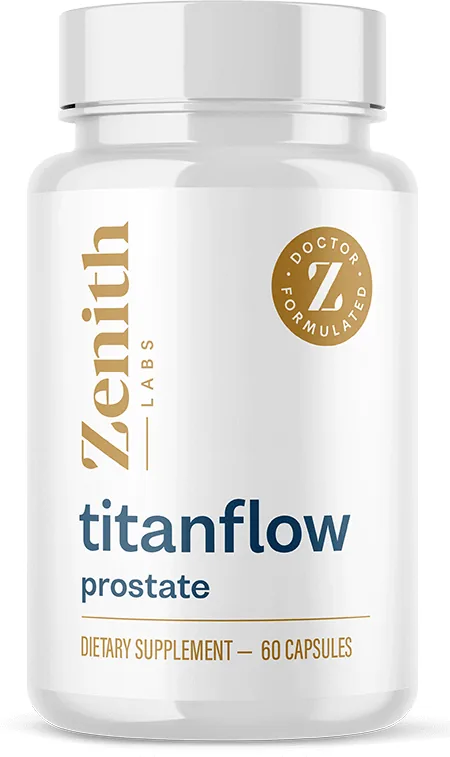
TitanFlow is a capsule sold by Zenith Labs and presented by Dr. Ryan Shelton, NMD, marketed to men over 40 for urinary flow. A bottle contains 60 capsules. The named ingredients are pumpkin seed oil, beta-sitosterol, lycopene, broccoli sprout extract and pygeum.
That ingredient list is, unusually for this category, a reasonable one. Beta-sitosterol and pygeum have some of the better evidence available for male lower urinary tract symptoms, and pumpkin seed oil has trials behind it too. Compared with products built on ingredients that have no urological research at all, this formula is aimed at the right target.
The mechanism the product is sold on is a different matter, and it is where this review spends most of its attention. TitanFlow is not marketed as a prostate supplement. It is marketed on the premise that the real cause of urinary symptoms is weakness in the walls of the urethra, that this affects half of men over 40, and that Johns Hopkins research established it. The headline promises "a powerful urinary flow without thinking twice about your prostate."
For men over 40 with urinary symptoms, "without thinking twice about your prostate" is a consequential thing to be told. Disclosure, as on every page of this site: we are independent reviewers, and purchases through our links may earn us a commission at no additional cost to you.
How Does It Work?
The proposed mechanism is stated clearly, which makes it straightforward to compare against how urologists describe the same symptoms.
The page argues that the prostate does enlarge with age and press on the urethra, but that a healthy urethra should withstand that pressure. It states that "for 50% of men over 40, their urethras have lost the strength to resist your body's natural pressures, making them prone to their urethra getting squeezed shut," and that the solution is to "support sturdy cellular walls in your urethra."
This is not how male lower urinary tract symptoms are understood. The recognized contributors are three, and urethral wall strength is not among them.
Static obstruction. Prostate tissue enlarging in the transition zone physically narrows the urethral channel. This is what 5-alpha-reductase inhibitors act on, by reducing gland volume over months.
Dynamic obstruction. Smooth muscle tone in the prostate and bladder neck contributes substantially to resistance, independent of size. This is what alpha-blockers act on, and it is why they work within days while the prostate remains the same size. It is also the best explanation for why prostate volume and symptom severity correlate so poorly.
Bladder function. Over time the detrusor muscle changes in response to working against resistance, and the resulting overactivity or underactivity drives much of the urgency and incomplete emptying men report. Bladder changes frequently persist after obstruction is relieved.
The urethra in men is a conduit. There is no recognized clinical entity of "weak urethral walls" causing obstruction, no standard measurement of urethral wall strength, and no treatment aimed at strengthening it. Where urethral structural problems do cause male urinary difficulty, the usual one is urethral stricture, which is scarring that narrows the channel, and the treatment is surgical rather than nutritional.
Urethral support is genuinely important in women, where weakness contributes to stress incontinence. That is the opposite problem: leakage rather than obstruction, and strengthening exercises target pelvic floor muscles rather than the urethra itself.
The Johns Hopkins Attribution
The page attributes its central premise to a specific institution, repeatedly.
"According to new Johns Hopkins research, those lucky people are blessed with a urethra that stays strong." "A study from Johns Hopkins University found something surprising." "Top researchers at Johns Hopkins Medical School have found that the nutrients in this oil are helping men to maintain control of their urinary habits."
No study is named. No author, no journal, no year, no title, no link. We could not locate published Johns Hopkins research establishing urethral wall weakness as a cause of male urinary symptoms, or establishing that pumpkin seed oil strengthens urethral walls.
Naming an elite institution supplies credibility that a citation would allow a reader to verify. Withholding the citation while keeping the institution is the part worth flagging, and it is a pattern we have documented before on this site.
Two accompanying figures have the same problem. "For 50% of men over 40" appears with "new research shows" and no source. "Taking pumpkin seed oil daily strengthened urethra walls, improving flow metrics by over 20%" appears with no source, and describes an outcome, urethral wall strengthening, that is not a measurement urological trials take.
Core Ingredients Analysis
No dose is published for any ingredient, despite the page stating they are combined "in optimal dosages." No supplement facts panel appears in the materials we examined.
| Ingredient | Dose stated | Evidence snapshot |
|---|---|---|
| Beta-sitosterol | None | Among the better-supported ingredients in this category. Cochrane review of beta-sitosterols for BPH found improvement in urinary symptom scores and peak flow, while noting trials were short and the compound does not reduce prostate size. |
| Pygeum africanum | None | Cochrane review found modest improvement in urologic symptoms and flow measures, with trials small and short and study quality limited. |
| Pumpkin seed oil | None | Several trials report modest symptom score improvements. Typically dosed at grams daily, which is relevant to whether a capsule can deliver it. |
| Lycopene | None | Studied mainly for prostate health and cancer risk in observational work. Not established for urinary flow. |
| Broccoli sprout extract | None | Sulforaphane is studied for antioxidant and detoxification pathways. No urinary flow evidence. |
Giving credit precisely. Beta-sitosterol and pygeum are not filler. Their Cochrane reviews are more favourable than what saw palmetto received, and saw palmetto is the ingredient most prostate supplements are built around. A formula pairing them is aimed at a defensible target.
Two qualifications belong alongside that. Both bodies of evidence rest on trials that were short and of variable quality, and neither compound reduces prostate volume. And the mechanism proposed for them in the research literature has nothing to do with urethral walls: the discussion involves 5-alpha-reductase activity, anti-inflammatory effects and alpha-adrenergic influence on smooth muscle tone. The product uses ingredients with real evidence and then attaches an explanation the evidence does not contain.
Why the missing doses matter here. Beta-sitosterol trials typically used 60 to 130 mg daily. Pygeum trials used around 75 to 200 mg. Pumpkin seed oil trials generally used amounts measured in grams. Those are checkable numbers, and a product claiming "optimal dosages" without printing any of them cannot be compared against them. In a 60-capsule bottle, whether the pumpkin seed oil reaches gram-scale quantities is precisely the question a label would answer.
Safety notes. Beta-sitosterol is generally well tolerated, with mild digestive effects most commonly reported. Pygeum can cause gastrointestinal upset. Most importantly for this category, saw palmetto and related botanicals can affect PSA readings in some circumstances, and any man taking a prostate-directed supplement should tell his doctor before a PSA test so the result is interpreted correctly.
The Message About the Prostate
This section carries more weight than the efficacy discussion, because it concerns what a reader does rather than what a capsule does.
The marketing's differentiator is that TitanFlow is not about the prostate. The headline offers flow "without thinking twice about your prostate." The body states that "focusing on your prostate is NOT the one-and-only, magical solution" and that "while other solutions try to shrink the prostate, TitanFlow is the ONLY one strengthening your urethra walls themselves."
As a marketing differentiator it is effective, because it distinguishes the product from a crowded shelf. As advice to men over 40 with new urinary symptoms it points the wrong way.
Urinary symptoms in men are usually caused by benign prostatic hyperplasia, which is not cancer and does not become cancer. They can also be caused by prostate cancer, bladder cancer, urinary tract infection, bladder stones, neurological conditions and diabetes. The symptoms overlap, which is exactly why evaluation exists and why symptom-based self-diagnosis is unreliable. The NIDDK's overview of prostate enlargement covers the evaluation process, and the American Urological Association's BPH guideline is what clinicians work from.
The likely outcome of an evaluation is reassurance, since most cases are benign. That is a reason to have one rather than a reason to skip it, and "without thinking twice about your prostate" encourages the opposite.
Real User Benefits & Drawbacks
Pros
- Beta-sitosterol and pygeum have some of the better Cochrane-reviewed evidence in this category.
- All five ingredients are named rather than hidden in a blend name.
- A 180-day "empty bottle" money-back guarantee, honoured even if the supply is used up.
- Explicitly a one-time payment with no subscription.
- The presenting physician is a named, identifiable figure rather than a pen name.
- ClickBank is the retailer, so refunds are processed by a third party.
- A single 30-day option at $59, so no bulk commitment is required.
Cons
- The urethral wall weakness mechanism is not a recognized cause of male urinary symptoms.
- Johns Hopkins research is invoked repeatedly with no study, author, journal or year.
- "50% of men over 40" and "improving flow metrics by over 20%" have no stated source.
- No dose for any ingredient, despite claiming "optimal dosages."
- Marketing explicitly encourages not thinking about the prostate.
- "The ONLY one strengthening your urethra walls" is a sole-solution claim for an unrecognized mechanism.
- No mention that prostate supplements can affect PSA interpretation.
Pricing, Packages & Refund Policy
A 30-day supply is offered at $59, shown against a $129 reference price, with 90-day and 180-day bundles at further discounts. The page states this is a one-time payment with no subscription and no hidden fees, and that the product is not sold in stores.
The refund term is genuinely strong and worth stating plainly: 180 days, described as an "empty bottle" guarantee, refunded even if the entire supply has been used. That removes the usual trap in this category, where a vendor recommends 90 to 180 days of use against a 60-day refund window. Here the window covers the recommended duration. ClickBank processes the transaction, so the route does not depend on the seller.
The standard urgency devices are present: "limited time," "selling out faster than we anticipated," and "the cheapest you'll ever see." These have been running continuously.
How It Compares to the Alternatives
| Comparison point | TitanFlow | Prosta Peak (also reviewed here) |
|---|---|---|
| Lead ingredient evidence | Beta-sitosterol, favourable Cochrane review | Saw palmetto, failed large trials |
| Doses published | None | None |
| Mechanism | Not a recognized entity | Overstated but recognized |
| Refund window | 180 days, empty bottle | 180 days |
| Entry price | $59 for 30 days | Comparable |
On ingredients, TitanFlow is ahead of most of this shelf. On mechanism honesty, it is behind, which is an unusual combination.
Against medical treatment, the comparison is direct. Alpha-blockers act within days on the smooth muscle tone that contributes most to dynamic obstruction. 5-alpha-reductase inhibitors reduce gland volume over months. Both have documented effect sizes and documented side effects, including sexual side effects that matter to many men and are worth discussing openly with a doctor. Combination therapy is standard where appropriate.
Non-drug measures with real support include adjusting evening fluid timing, reducing alcohol and caffeine, double voiding, bladder training, and reviewing medications, since antihistamines and decongestants can worsen symptoms noticeably.
What the Independent Research Actually Says
On beta-sitosterol. The Cochrane review of beta-sitosterols for benign prostatic hyperplasia found improvement in urinary symptom scores and peak urine flow compared with placebo, while noting that trials were short and that the compound does not reduce prostate size. This is a genuinely positive finding by the standards of this category.
On pygeum. The Cochrane review of Pygeum africanum for benign prostatic hyperplasia found modest improvement in urologic symptoms and flow measures, with the caveat that studies were small, short and of variable quality.
On the mechanism. Urological literature on lower urinary tract symptoms discusses static obstruction, dynamic obstruction and bladder dysfunction. Urethral wall strength does not appear as a target, and there is no standard measurement of it.
On the finished product. No clinical trial of TitanFlow appears in the indexed literature. The evidence is ingredient-level, at doses this product does not disclose.
What to Expect: A Realistic Timeline
Weeks one to four. Little should be expected. The ingredient trials that found effects measured them over months.
Months two to three. The window in which the beta-sitosterol and pygeum trials assessed symptom scores. Whether this product delivers comparable doses is not knowable from the label.
Months four to six. Still within the 180-day refund window, which is genuinely unusual and worth noting.
An important caution for self-assessment in this category: urinary symptoms fluctuate substantially on their own, with fluid intake, caffeine, alcohol, sleep and season. Placebo response in BPH trials is notably large, which is why the trials that matter are placebo-controlled and why a few weeks of personal impression is weak evidence in either direction.
Who This Applies To, and Who Should Avoid It
Any man with new or worsening urinary symptoms should be evaluated before treating them, whatever he then decides to take. That is the single most useful sentence in this review. Blood in the urine, pain on urination, fever with urinary symptoms, or inability to pass urine at all require prompt medical attention, the last of them urgently.
Anyone taking a prostate-directed supplement should tell their doctor before a PSA test, so the result is interpreted with that information available.
Anyone already taking an alpha-blocker or 5-alpha-reductase inhibitor should discuss adding a supplement with the prescriber rather than combining independently.
Men whose symptoms are mild and who have been evaluated may reasonably consider watchful waiting alongside lifestyle measures, which is a recognized management approach and costs nothing.
Frequently Asked Questions
Is urethral wall weakness a real cause of urinary problems in men?
It is not a recognized clinical entity in male lower urinary tract symptoms. Urologists describe three contributors: static obstruction from prostate tissue, dynamic obstruction from smooth muscle tone at the bladder neck and prostate, and changes in bladder function. There is no standard measurement of urethral wall strength and no treatment aimed at it. Urethral stricture, which is scarring, is a different problem treated surgically.
Is there Johns Hopkins research behind TitanFlow?
The sales page attributes its central premise to Johns Hopkins repeatedly without naming a study, author, journal or year. We could not locate published Johns Hopkins research establishing urethral wall weakness as a cause of male urinary symptoms or showing that pumpkin seed oil strengthens urethral walls. The accompanying figures, "50% of men over 40" and "improving flow metrics by over 20%," also appear without sources.
Are the ingredients any good?
Better than most in this category. The Cochrane review of beta-sitosterols for BPH found improvement in urinary symptom scores and peak flow, and the pygeum review found modest improvement in symptoms and flow measures. Both note short trials of variable quality, and neither compound reduces prostate size. No dose is published for any ingredient here, so the product cannot be compared against the trial doses.
Should I skip a prostate check if I take this?
No. The marketing offers urinary flow "without thinking twice about your prostate," and that points the wrong way for men over 40 with new symptoms. Urinary symptoms are usually caused by benign prostatic hyperplasia, but they can also indicate prostate or bladder cancer, infection, stones, neurological conditions or diabetes, and the presentations overlap. Evaluation usually brings reassurance, which is a reason to have one.
What does TitanFlow cost and what is the refund policy?
A 30-day supply is $59 against a $129 reference price, with 90-day and 180-day bundles discounted further. The stated guarantee is 180 days and is described as an empty bottle guarantee, refunded even if the whole supply has been used. It is a one-time payment with no subscription, and ClickBank is the retailer, so refunds are processed by the platform.
Final Verdict: Is TitanFlow a Scam or Legit?
TitanFlow gets something right that most of this category gets wrong. Beta-sitosterol and pygeum carry Cochrane reviews reporting improvement in urinary symptom scores and flow measures, which is more than can be said for saw palmetto, the ingredient most prostate supplements are built on. All five ingredients are named. The refund term is 180 days and honoured on empty bottles, which covers the full period the vendor recommends rather than expiring before it. There is no subscription, the presenting physician is a real identifiable figure rather than a pen name, and a single-month option exists.
The explanation attached to those ingredients is invented. Male lower urinary tract symptoms are understood in terms of prostate tissue narrowing the channel, smooth muscle tone at the bladder neck and prostate, and changes in bladder function. Urethral wall weakness is not a recognized cause, there is no standard measurement of it, and no treatment targets it. The compounds in this bottle do have proposed mechanisms in the research literature, involving 5-alpha-reductase activity, inflammation and smooth muscle tone, and none of them is the story on this page.
That story is attributed to Johns Hopkins four times without a single citation, alongside two statistics, "50% of men over 40" and "over 20%" improvement in flow metrics, that appear with no source and describe a measurement urological trials do not take. And the product claims "optimal dosages" while publishing no dose at all, in a category where the trial doses for its two best ingredients are specific and checkable.
The part that concerns us most is not the mechanism but the instruction. "A powerful urinary flow without thinking twice about your prostate" is the headline, and the body reinforces it. Urinary symptoms in men over 40 are usually benign, and they also overlap with prostate cancer, bladder cancer, infection and neurological conditions, which is why evaluation exists. Telling that audience to stop thinking about the prostate is the one message in this review with a plausible cost attached.
For a man with these symptoms, the sequence is evaluation first, because it usually brings reassurance and occasionally catches something that matters. Then the options: watchful waiting with fluid timing, caffeine and alcohol adjustment, bladder training and a medication review, or alpha-blockers and 5-alpha-reductase inhibitors where indicated, with their real benefits and real side effects discussed openly.
Our rating: 3.6/5. This sits in our floor band (see how we rate), where we place a product with a documented integrity problem rather than merely thin evidence. Two reasons. First, the central mechanism, urethral wall weakness affecting "50% of men over 40," is attributed to Johns Hopkins research four times without naming a study, author, journal or year, and it is not a recognized cause of male urinary symptoms. Second, the marketing directs its audience away from prostate evaluation, promising flow "without thinking twice about your prostate," to men in the age group where those symptoms warrant assessment. Credited, and genuinely, for beta-sitosterol and pygeum as ingredients with favourable Cochrane reviews, all five ingredients named, a 180-day empty-bottle guarantee that covers the recommended usage period, no subscription, a named identifiable physician, and a single-month entry option. Docked for an unrecognized mechanism, uncited institutional attribution, two unsourced statistics, no dose published despite claiming optimal dosages, a sole-solution claim, and no mention that prostate supplements can complicate PSA interpretation.