
Introduction & What Is ProvaDent?
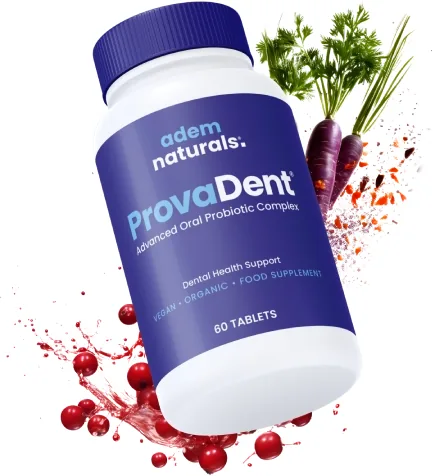
ProvaDent is a chewable oral probiotic tablet sold under the Adem Naturals label. A bottle contains 60 tablets, and the instruction is two per day, chewed like a breath mint, ideally after breakfast and before bed. The marketing positions it as an oral microbiome product: rather than killing bacteria the way a mouthwash does, it is described as repopulating the mouth with beneficial species.
That premise is not fringe. The oral microbiome is a genuine and active research field, the link between specific bacteria and dental disease is well established, and the idea that the composition of the mouth's bacterial community matters is mainstream dentistry. Products in this space start from a more credible foundation than most supplement categories.
Two things about ProvaDent specifically shape this review. The first is what the label does and does not say: five ingredient categories are named, and not one of them comes with a dose, and the four probiotic strains are never identified. For a probiotic, that omission is more consequential than it sounds, and the ingredients section explains why. The second is a sentence in the vendor's own footer disclaimer about the dentist whose name and image front the sales page. Disclosure, as on every page of this site: we are independent reviewers, and purchases through our links may earn us a commission at no additional cost to you.
How Does It Work?
The mechanism the marketing describes has three parts, and they differ in how well the underlying science supports them.
Displacing harmful bacteria with beneficial ones. The sales page states that ProvaDent "helps keep bad bacteria under control, while repopulating your mouth with good bacteria." The underlying concept, sometimes called bacterial replacement therapy, is a real line of research. The mouth hosts several hundred bacterial species, and dental caries is associated with a shift toward acid-producing organisms rather than with bacteria as such. Whether a chewed tablet establishes a durable population change is a separate question from whether the concept is sound, and it is the question the evidence is thinnest on.
Targeting Streptococcus mutans. The FAQ states that ProvaDent "contains specific probiotic strains that attack strep mutans, which are the reason you get cavities." S. mutans is genuinely central to caries research, and it is one of the most studied organisms in dentistry. The phrasing overstates two things. Cavities result from an interaction between diet, particularly fermentable carbohydrate frequency, saliva, fluoride exposure, oral hygiene and the bacterial community, and attributing them to one organism is a simplification the field moved past some time ago. And "attack" describes an outcome that would need to be demonstrated for the specific strains in this product, which are not named.
Destroying biofilm. The page states that "the BioFresh Clean in every tablet targets and destroys biofilm, the sticky film on your teeth where harmful bacteria grow." Dental plaque is a biofilm, and biofilms are genuinely difficult to disrupt: the extracellular matrix that holds them together is a large part of why brushing is mechanical rather than chemical. A claim that an ingested chewable destroys it is a strong claim, and the compound said to do so, BioFresh Clean Complex, is described only as "our proprietary blend of natural ingredients." There is no published research on it because it is a trade name rather than a studied compound.
A fourth claim appears in the FAQ and moves beyond the mouth: "every time you swallow you're sending good bacteria down the intestinal and respiratory pathways, and into your gut microbiome." Swallowed bacteria do reach the gut, subject to gastric acid survival, which varies substantially by strain. The reference to the respiratory pathway does not describe a route that swallowing takes.
Core Ingredients Analysis
Five components are named. None carries a quantity, and the tablet has no published supplement facts panel in the pre-purchase materials.
| Ingredient | Dose stated | Evidence snapshot |
|---|---|---|
| Organic xylitol | None | The best-supported inclusion. A sugar alcohol that oral bacteria cannot ferment into acid, studied for decades in caries prevention. Effects in trials are associated with regular exposure across the day, typically several grams daily. |
| 4 strains of probiotics | None, and no strains named | Cannot be assessed. Probiotic evidence is strain-specific, and no CFU count is given either. |
| BioFresh™ Clean Complex | None | A trade name for an undisclosed proprietary blend. No published research exists on it. It carries the biofilm claim. |
| Cranberry extract | None | Proanthocyanidins have been studied for interfering with bacterial adhesion, mostly in laboratory and urinary tract contexts. Oral applications are preliminary. |
| Purple carrot powder | None | Described on the page as contributing to "overall well-being." No specific oral health evidence. |
Why the missing strain names matter more here than a missing dose usually would. This is the central technical point of the review, and it is worth stating carefully. Probiotic effects do not belong to a species, they belong to a strain. Lactobacillus reuteri DSM 17938 and Lactobacillus reuteri ATCC 55730 are the same species and behave differently. In oral research specifically, the strains with the most published work behind them, such as Streptococcus salivarius K12 and M18, and certain L. reuteri strains, are always identified by their full designation, because that identifier is what connects a product to a body of evidence.
ProvaDent states that it contains four strains and does not say which. There is therefore no way to look up what they do, no way to check whether they have been studied for oral outcomes at all, and no way to connect the product to any of the research the concept borrows credibility from. A proprietary blend at least tells a reader what is present while withholding the split. Here the identity itself is withheld, and identity is the entire basis of probiotic evidence.
The absence of a CFU count compounds this. Colony-forming units are the standard measure of viable organisms in a probiotic, they appear on most products in the category, and their absence means the quantity of the active component is unstated as well as its identity.
On xylitol, the ingredient with real support. The evidence is genuine and also more qualified than marketing usually conveys. Xylitol is not fermented into acid by oral bacteria, and trials have examined it for caries reduction, with results that vary by delivery format, dose and frequency. Cochrane's review of xylitol for preventing dental caries found the evidence base limited and of low quality overall. The doses associated with effects in the literature are typically several grams daily spread across multiple exposures, which is a meaningful amount of a bulk ingredient. Whether two tablets deliver it is unknowable without a quantity on the label. Xylitol is also seriously toxic to dogs, which is worth knowing in a household with a pet and a chewable that tastes like a mint.
The Dentist on the Sales Page
The sales page presents Dr. Andrew Knudson as the authority behind ProvaDent, with his name, photograph and clinical framing used throughout, alongside an "As Seen On" row of media and institutional logos.
The vendor's own footer disclaimer states: "Dr. Andrew Knudson is a fictionalized character and is a pen name."
We are reporting this as a factual discrepancy between two parts of the same website rather than characterizing intent. The disclosure exists, which distinguishes this from a concealed fabrication, and it appears in small print at the bottom of a long page rather than beside the photograph. The practical consequence for a reader is direct: the professional credential that the page uses to establish trust is not attached to a person who can be looked up, whose registration can be verified, or who can be held to a professional standard.
The same footer notes that the "As Seen On" organizations do not endorse, sponsor or have any affiliation with him, and that "some names and personal identifying information on this site have been changed," which applies to the testimonials labelled "Verified Purchase."
This is the finding that sets ProvaDent's rating, for reasons set out in the verdict.
Real User Benefits & Drawbacks
Pros
- Xylitol is a legitimate inclusion with a real, if qualified, evidence base in dentistry.
- The oral microbiome premise is scientifically sound as a concept, unlike many supplement mechanisms.
- ClickBank is the retailer, so refunds are processed by a third party rather than at the seller's discretion.
- A 60-day money-back guarantee that the FAQ states applies even to unused product.
- A single-bottle option at $69 means no bulk commitment is required to start.
- A physical return address and a product support phone number are published.
- Chewing two tablets daily is a simple routine with no preparation.
Cons
- The four probiotic strains are not identified, which makes the central ingredient impossible to evaluate.
- No CFU count and no doses for any ingredient.
- The dentist fronting the page is described in the vendor's own disclaimer as a fictionalized character and pen name.
- "BioFresh Clean Complex" is a trade name for an undisclosed blend, and it carries the biofilm claim.
- "All of the ingredients in ProvaDent have been proven to be safe in clinical trials" overstates what can be established for an undisclosed formulation.
- The $199 single-bottle reference price appears alongside a permanent $69 price.
- Testimonials are labelled "Verified Purchase" while the footer notes names and identifying details have been changed.
Pricing, Packages & Refund Policy
Three packages are offered. One bottle, a stated 30-day supply, at $69, shown against a $199 reference price. Three bottles at $177, or $59 each, with free US shipping and two digital bonus guides. Six bottles at $294, or $49 each, with free shipping and the same bonuses. The page states that 87 percent of customers choose the six-bottle option.
The reference prices deserve a plain note. A $199 single bottle discounted to $69, and a $1,194 six-pack discounted to $294, describe a roughly 75 percent reduction that is presented as a limited offer and appears to be the standing price. This framing is close to universal in the category, and readers should treat the crossed-out figures as marketing rather than as a price the product has traded at.
The refund terms are among the better ones we have documented. The FAQ states that a buyer can request a full refund "even if you don't wind up using it for any reason," within 60 days, by emailing customer support. ClickBank processes the transaction, so the refund route does not depend on the vendor's cooperation. A product support phone number and a physical return address in Tallmadge, Ohio are published.
One arithmetic note for anyone considering the recommended package: the six-bottle option is a 180-day supply and the refund window is 60 days, so roughly two thirds of the purchase falls outside the period in which it can be returned.
How It Compares to the Alternatives
Against other oral probiotics, the transparency comparison is unfavourable in a specific way. ProDentim, which we have also reviewed, names its strains, and DentaBiome does likewise. Naming strains does not make a product effective, and we were critical of both on other grounds. It does make a product assessable, and it is the minimum a reader needs to check whether the organisms in a tablet have been studied for the outcome being sold.
| Comparison point | ProvaDent | Category norm |
|---|---|---|
| Probiotic strains identified | No | Usually yes, with full designations |
| CFU count published | No | Usually yes |
| Ingredient doses | None stated | Often a proprietary blend total |
| Refund window | 60 days, unused product included | 60 to 180 days |
| Entry price | $69 single bottle | Frequently $69 |
Against non-commercial alternatives, the comparison is the one the dental profession has been making for a century. Toothbrushing with fluoride toothpaste, interdental cleaning, limiting the frequency of fermentable carbohydrate rather than only the amount, and regular professional examination remain the established basis of oral disease prevention. The NIDCR's overview of tooth decay sets out what the evidence supports. Fluoride in particular has an evidence base that no supplement in this category approaches.
What the Independent Research Actually Says
On oral probiotics generally. Research on probiotics for oral health has grown considerably, and the findings are genuinely mixed and mostly preliminary. Studies have examined effects on gingival inflammation, plaque indices, halitosis and S. mutans counts, with some positive results, small sample sizes, short durations and considerable heterogeneity between strains and formats. The published trial literature on oral probiotics and caries shows both the volume of interest and the inconsistency of results. Reductions in S. mutans counts, where observed, have not consistently translated into demonstrated reductions in cavities, which is the outcome that matters.
On strain specificity. This is settled ground in probiotic science rather than a matter of opinion. Effects demonstrated for one strain cannot be attributed to another strain of the same species, which is why regulatory and scientific guidance consistently requires full strain designation. A product that does not identify its strains cannot inherit the evidence generated by studied ones.
On xylitol. Genuine evidence, qualified by trial quality. The mechanism is well characterized and the effect appears to depend on dose and frequency of exposure rather than mere presence. The American Dental Association's review of sugar-free gum and xylitol covers what the evidence supports and where it is limited.
On the finished product. No clinical trial of ProvaDent appears in the indexed literature. This is typical of the category and not a specific criticism, though it means the ingredient-level evidence is all there is, and here that evidence is available for one of the five components.
On regulation. Under the FDA's dietary supplement framework, products are not reviewed for safety or efficacy before marketing, and the statement that ingredients "have been proven to be safe in clinical trials" is a manufacturer's claim rather than a regulatory finding.
What to Expect: A Realistic Timeline
Days one to seven. A chewable tablet twice daily. Xylitol has a mild sweetness. Some people experience digestive effects from sugar alcohols, generally at higher intakes than a tablet is likely to provide.
Weeks two to four. Breath is the outcome people most often report noticing first with oral probiotics, and it is also the outcome most susceptible to expectation, since self-assessment of one's own breath is unreliable. Any change here is worth treating cautiously as evidence.
Weeks four to eight. If a bacterial shift occurs, this is roughly the window in which studies have looked for it, generally using laboratory counts rather than symptoms. The 60-day refund window closes at around week eight.
Months three and beyond. Caries and periodontal disease develop and are assessed over months to years, which is why the meaningful outcomes in this field are measured at dental examinations rather than felt. A person cannot detect a cavity that did not form.
The general point, which applies well beyond this product: the outcomes oral probiotics are sold for are mostly not perceptible to the person taking them. That makes personal impressions a poor guide and professional examination the relevant check.
Who This Applies To, and Who Should Avoid It
Anyone with bleeding gums, persistent bad breath, tooth sensitivity or visible plaque accumulation should be assessed by a dentist rather than treating the symptom with a supplement. Bleeding gums in particular are the presenting sign of gingivitis and periodontitis, both of which are treatable and both of which progress if left. The testimonial on ProvaDent's page describing bleeding that "completely stopped" within days is exactly the scenario in which a dental examination matters, because untreated periodontal disease causes irreversible bone loss.
People who are immunocompromised, who have had cardiac valve surgery, or who have a central line should discuss any probiotic with their doctor, as live organisms carry different considerations for them. Anyone on prescription medication should review a full ingredient list with a clinician, which in this case is not possible before purchase.
Households with dogs should note that xylitol is highly toxic to them, and a chewable mint-like tablet is a plausible thing for a dog to find.
Frequently Asked Questions
What is in ProvaDent?
Five components are named: organic xylitol, a proprietary "BioFresh Clean Complex," cranberry extract, purple carrot powder, and four probiotic strains. No doses are given for any of them, no CFU count is published, and the four strains are not identified. A bottle contains 60 chewable tablets, taken two per day.
Why does it matter that the probiotic strains are not named?
Probiotic effects are strain-specific rather than species-specific, which is settled in the field. Two strains of the same species can behave differently, so research findings cannot be transferred between them. Studied oral strains are always identified by full designation, such as Streptococcus salivarius K12. Without those identifiers there is no way to determine whether the organisms in a product have been studied for oral outcomes at all.
Is Dr. Andrew Knudson a real dentist?
The vendor's own footer disclaimer states that "Dr. Andrew Knudson is a fictionalized character and is a pen name." His name and image are used throughout the sales page as the clinical authority behind the product. The same disclaimer notes that the "As Seen On" organizations shown on the page have no affiliation with or endorsement of him.
Does ProvaDent destroy plaque or biofilm?
That claim is attributed to "BioFresh Clean Complex," a trade name for an undisclosed proprietary blend with no published research. Dental plaque is a biofilm whose extracellular matrix makes it resistant to disruption, which is why mechanical removal by brushing and interdental cleaning remains the established approach. The available evidence is insufficient to conclude that a chewed tablet removes biofilm.
What does ProvaDent cost and what is the refund policy?
One bottle is $69, three are $177, and six are $294 with free US shipping and two digital bonuses. The stated policy is a 60-day money-back guarantee that the FAQ says applies even to unused product, requested by email to customer support. ClickBank is the retailer, so refunds are processed through the platform. The six-bottle package is a 180-day supply, so most of it falls outside the refund window.
Final Verdict: Is ProvaDent a Scam or Legit?
ProvaDent is a real product that ships. It has a named company, a published physical return address and support phone number, ClickBank as retailer, and refund terms that are more generous than most in the category, covering unused product for 60 days. It contains xylitol, which is a legitimate ingredient with a genuine evidence base in dentistry. Its premise, that the composition of the oral microbiome matters, is sound science rather than invented mechanism. These are real points and we want them stated clearly.
The product's central component cannot be evaluated. It is sold as an oral probiotic, and it does not say which probiotics it contains. Strain specificity is not a technicality in this field, it is the basis on which probiotic evidence is organized, and four unnamed strains with no CFU count cannot be connected to any published research. The compound carrying the strongest claim on the page, that it "targets and destroys biofilm," is a trade name for an undisclosed blend. The one ingredient with real evidence behind it, xylitol, has no stated quantity, and the literature indicates its effect depends on dose and frequency of exposure.
Then there is the sentence in the vendor's own footer. "Dr. Andrew Knudson is a fictionalized character and is a pen name." The page uses that name, that photograph and that clinical framing to establish why a reader should trust what follows, and the disclaimer at the bottom of the same page states that the person does not exist. The disclosure is present, and we credit that it is present. It does not change what the top of the page is doing.
For anyone whose actual concern is bleeding gums, persistent bad breath or the state of their teeth, the established path has not changed: a dental examination, because gingivitis and early periodontal disease are treatable and both progress when they are not; brushing with fluoride toothpaste; interdental cleaning; and attention to how often, rather than only how much, fermentable carbohydrate is eaten. The NIDCR guidance covers it, none of it is novel, and all of it rests on more evidence than anything in this bottle.
Our rating: 3.5/5. That is the floor of our scale: we do not publish a score below 3.5 (see how we rate), so where a product's conduct would otherwise rank lower, the specifics carry the weight instead of the number. Here it is, quoted from the vendor's own materials: "Dr. Andrew Knudson is a fictionalized character and is a pen name." A fabricated clinical expert used to establish authority for a health product is the most serious category of claim our rubric recognizes, and it is compounded by testimonials labelled "Verified Purchase" beside a disclaimer that identifying details were changed. Credited for xylitol as a genuine inclusion, a scientifically sound premise, a refund policy that covers unused product, published support contacts and a single-bottle entry option. Docked for four unidentified probiotic strains, no CFU count, no doses anywhere on the label, a biofilm claim resting on an undisclosed trade-name blend, and "proven to be safe in clinical trials" stated for a formulation that is not published.