
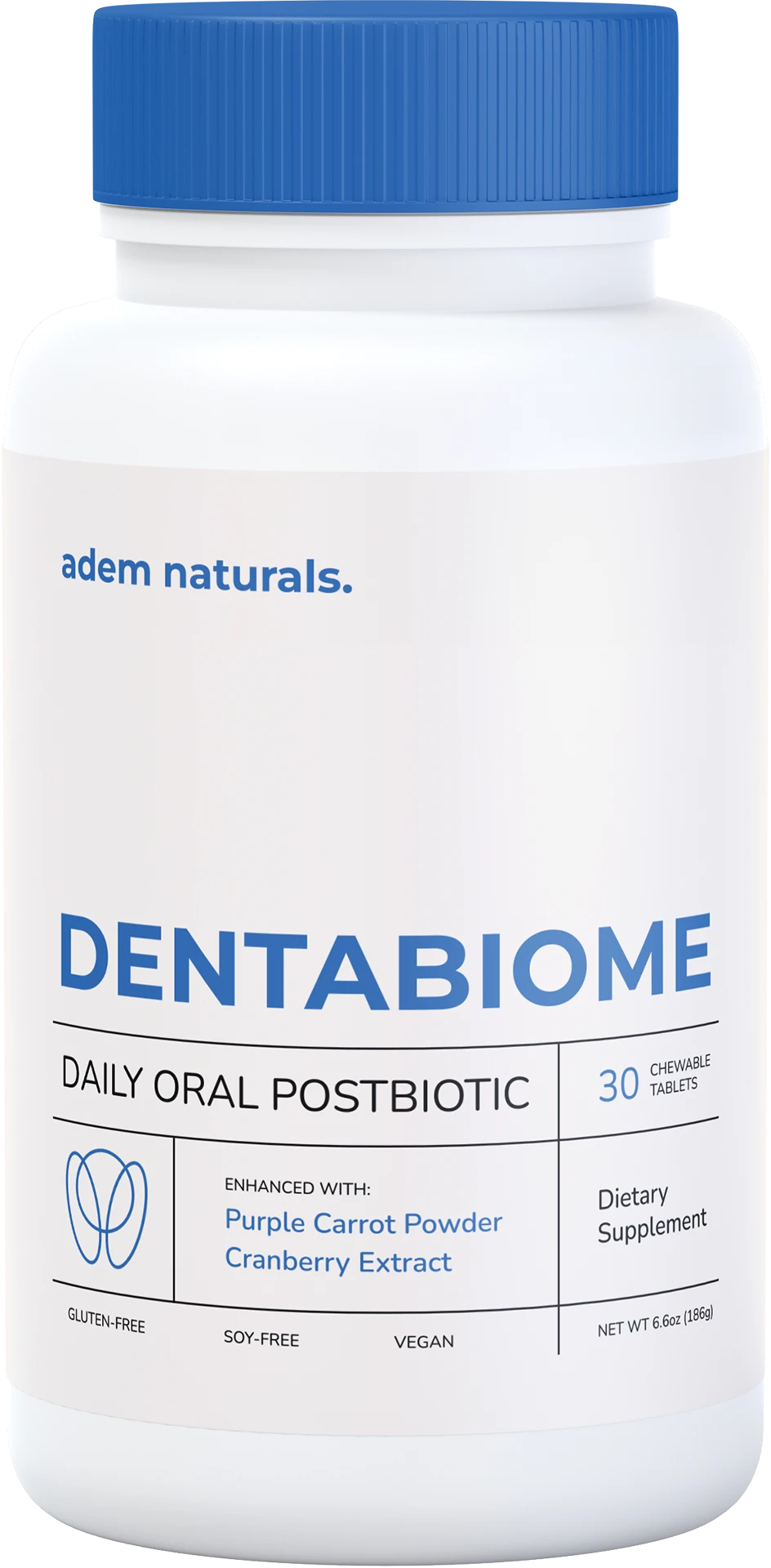
Introduction & What Is DentaBiome?
The idea behind oral probiotics is genuinely interesting, and increasingly researched: the mouth hosts its own microbial community, and the balance of that community influences whether cavities and gum trouble take hold. DentaBiome is one of a growing number of products betting that adding "good" bacteria could tilt that balance in a healthier direction. It comes as a chewable tablet built around Lactobacillus salivarius, Lactobacillus rhamnosus and xylitol, taken once a day.
That format choice is the first thing worth noting, because it is the right one for the category. A probiotic meant to act in the mouth should stay in the mouth; a chewable that dissolves against the teeth and gums does that, where a swallowed capsule would wash straight past the site it is supposed to influence. So DentaBiome starts from a sensible premise rather than a marketing invention.
The product targets adults who keep getting cavities despite brushing, who worry about plaque and enamel, and who are curious whether the microbiome approach that reshaped gut-health conversations applies to teeth. The manufacturer positions it as support for a balanced oral environment, not as a replacement for brushing, fluoride or dental care, and that boundary stays central to this review.
Below: the strain-by-strain evidence, what xylitol does and does not do, honest pros and cons, pricing with refund terms, and a realistic timeline. Disclosure, as on every page of this site: we are independent reviewers, and purchases through our links may earn us a commission at no additional cost to you.
How Does It Work?
DentaBiome's proposed mechanism has two parts. The first is competitive colonization: the theory that introducing benign strains can crowd out or suppress cavity-associated bacteria, chiefly Streptococcus mutans, which ferments sugars into the acids that dissolve enamel. Certain Lactobacillus and Streptococcus salivarius strains have been studied for exactly this, with some trials reporting lower mutans counts during use. The second is xylitol, a sugar alcohol that mutans bacteria cannot ferment; it is the most evidence-backed ingredient in the formula, with a reasonable literature on reducing cavity-causing bacteria and supporting saliva.
An important honesty check on the mechanism: strain specificity matters enormously in probiotics. A benefit shown for one strain does not transfer to another strain of the same species, and much oral-probiotic research has used specific strains (such as certain S. salivarius or L. reuteri strains) that may differ from what any given product contains. Effects during use also appear to fade after stopping, since introduced strains rarely take up permanent residence.
The wider scientific picture: the concept is legitimate and actively studied, xylitol has real supporting evidence, and specific probiotic strains have shown short-term effects on oral bacteria. At the same time, the finished DentaBiome formula has no independent trials, strain-level results do not automatically apply to this blend, and no probiotic reverses existing cavities or replaces the established trio of brushing, fluoride and professional care. It is best understood as a possible adjunct, not a treatment.
Core Ingredients Analysis
| Ingredient | What the manufacturer includes it for | Evidence snapshot |
|---|---|---|
| Lactobacillus salivarius | Oral strain intended to compete with cavity bacteria. | Some small studies show effects on oral bacteria and gum markers; results are strain- and study-dependent. |
| Lactobacillus rhamnosus | Well-known probiotic species included for oral balance. | Extensively studied overall; specific oral-cavity evidence is more limited and mixed. |
| Xylitol | Non-fermentable sweetener that starves cavity bacteria. | The best-supported ingredient here: reasonable evidence for lowering mutans counts and supporting saliva. |
| Additional oral strains & support blend | Broader microbiome coverage per the label. | Concept is legitimate; effect depends entirely on the specific strains and doses, which are not fully disclosed. |
What stands out positively: the format fits the goal, xylitol is a genuinely evidence-based inclusion, and the named Lactobacillus strains are plausible choices grounded in real research directions.
What deserves scrutiny: the marketing does not publish the exact strain designations (the letter-and-number codes that determine whether a study applies) or the CFU counts, and in probiotics those details are the whole story. Without them, matching DentaBiome to the trials it implicitly borrows from is impossible before purchase.
Safety notes: these strains and xylitol are generally well tolerated, with mild digestive upset the most common complaint. Immunocompromised people and those under active medical or dental treatment should check with a professional first. One practical warning: xylitol is highly toxic to dogs, so store the bottle well out of a pet's reach. For related everyday oral concerns, see our article on bad breath that persists even after brushing.
Real User Benefits & Drawbacks
Pros
- Format matches the goal: a chewable keeps the strains in the mouth, where oral probiotics are meant to act.
- Xylitol is a genuinely evidence-supported ingredient for reducing cavity-causing bacteria.
- The oral-microbiome concept is legitimate and actively researched, not invented for the product.
- 60-day money-back guarantee processed through ClickBank's retail system.
Cons
- Strain designations and CFU counts are not disclosed; in probiotics, those details determine whether any study applies.
- No independent trials of the finished product; strain-level evidence does not transfer automatically.
- Effects likely fade after stopping, since introduced strains rarely colonize permanently.
- Cannot reverse existing cavities or replace brushing, fluoride and dental visits.
Pricing, Packages & Refund Policy
DentaBiome is sold in single, 3-bottle and 6-bottle packages through the official website only. At the time of writing, a single bottle (a 30-day supply) is listed at a promotional price of around $49 against a stated regular price near $79, with bundles bringing the per-bottle price down (the 6-bottle package has been observed near $49 per unit and lower during promotions), plus free U.S. shipping on larger orders. Confirm live pricing on the official page, as ClickBank offers change often.
For scale: oral-probiotic studies typically ran several weeks to a few months, so a fair personal trial spans two to three bottles rather than one.
The stated refund policy is a 60-day money-back guarantee on every package bought through the official website, processed through ClickBank's standard retail support. Keep the order confirmation email.
How It Compares to the Alternatives
Against plain xylitol products: xylitol gum and mints deliver the formula's best-supported ingredient directly, cheaply and with a chewing action that also stimulates saliva. If the xylitol mechanism is the appeal, this is the low-cost way to test it.
Against other oral probiotics: several competitors, including our reviewed ProDentim, occupy the same shelf. The honest differentiator between them is not marketing but strain transparency, and most products in the category, DentaBiome included, disclose too little to compare rigorously. ProDentim leans toward gum health and breath; DentaBiome frames itself around decay and enamel.
Against the established basics: fluoride toothpaste, twice-daily brushing, flossing, limiting sugar frequency and regular dental cleanings have decades of evidence behind them. No probiotic approaches that record, and any benefit from DentaBiome would sit on top of those basics, never in place of them.
Against professional treatment: an actual cavity needs a dentist. Products in this category are for maintaining a healthier baseline, not for fixing decay that has already started, which only a dental professional can address.
What the Independent Research Actually Says
How cavities actually form. The NIH's dental institute (NIDCR) publishes a clear, vendor-free explanation of tooth decay, the bacteria, the acid, the role of sugar frequency and fluoride. It is the right baseline for judging any product's claims.
Xylitol's evidence. The best-supported ingredient here has a real, if debated, literature; this PubMed search on xylitol and caries shows both the supportive findings and the reviews that temper them.
Oral probiotics, the honest state of the field. The concept is promising and unsettled; this PubMed search on oral probiotics and S. mutans shows short-term effects in some trials and the recurring caveats about strain specificity and durability.
What actually prevents decay. The American Dental Association's consumer resource on fluoride summarizes the intervention with the strongest evidence, useful context for keeping a probiotic in its supporting-role place.
The regulatory frame. DentaBiome is regulated as a supplement, not a drug, under the FDA's dietary supplement framework, with no pre-market efficacy review, which is why the refund route matters in our verdict.
The wider context. If the reason you are here is a run of cavities despite careful brushing, the causes are worth understanding first. Our guide on why adults still get cavities covers what drives decay beyond hygiene, and which of those factors a probiotic does not touch.
What to Expect: A Realistic Timeline
- Days 1–14: Some users report a fresher mouth feel, largely a xylitol-and-saliva effect. This is not evidence of reduced decay, only of a pleasant immediate sensation.
- Weeks 3–8: The window where oral-bacteria studies measured shifts. There is no home way to count your mutans levels, so the honest metric is your dentist's assessment at your next cleaning, not a feeling.
- Next dental visit: the real checkpoint. Ask your dentist directly about plaque, early lesions and overall risk. Their objective read, not the product's marketing, is what should decide whether you continue.
Throughout: keep brushing with fluoride, flossing and attending regular cleanings. A probiotic is an addition to those, and any tooth pain or visible decay is a reason to see a dentist promptly, not to reach for a supplement.
Who the Evidence Applies To, and Who Should Avoid It
Oral probiotic research has been conducted largely in adults and children with measurable cavity risk, tracking bacterial counts over weeks to a few months, using specific named strains. That last detail is the one that decides applicability, and it is worth restating plainly: a trial showing that a particular strain reduced Streptococcus mutans counts says nothing about a different strain of the same species. When a product does not publish its strain designations, as DentaBiome does not, no reader can determine whether the borrowed research describes what is in the bottle. That is not a reason to assume the worst; it is a reason to recognize that the question is unanswerable from the outside.
The xylitol evidence has a clearer shape and a specific catch. Its studied effect depends on frequency and total daily exposure: the trials that found reductions in cavity-causing bacteria generally used xylitol several times a day, which is why xylitol gum studies exist in the form they do. A once-daily chewable delivers a fraction of that exposure pattern. The ingredient is legitimate; the dosing schedule is a meaningful departure from the research it draws on.
Some groups should check with a professional first. People who are immunocompromised, who have had heart valve surgery or endocarditis, or who are receiving chemotherapy should discuss any live-bacteria product with their doctor, since probiotic bacteremia, while rare, is documented in vulnerable patients. Anyone in active dental treatment should tell their dentist what they are taking, simply so the clinical picture is complete.
One practical warning bears repeating because the consequence is severe rather than theoretical: xylitol is highly toxic to dogs, causing dangerous drops in blood sugar and liver failure at doses a curious animal could easily reach from a chewed bottle. Any household with a dog should store this well out of reach, and treat a chewed container as a veterinary emergency rather than a wait-and-see situation.
Finally, the group for whom this product is the wrong tool: anyone with tooth pain, visible decay, a broken filling or bleeding that does not settle. Those are dental problems with dental solutions, and no probiotic addresses any of them.
Frequently Asked Questions
What is DentaBiome?
A chewable daily oral probiotic combining strains such as Lactobacillus salivarius and Lactobacillus rhamnosus with xylitol, marketed to support the mouth's bacterial balance. It is a supplement, not a medication.
Does DentaBiome prevent cavities?
Some strains and xylitol have research suggesting lower cavity-associated bacteria, but results are mixed and the finished formula is untested. The available evidence is insufficient to conclude it prevents cavities; brushing, fluoride and dental visits remain the established tools.
Why is it chewable instead of a capsule?
Oral probiotics aim to act in the mouth, so a chewable keeps the strains where they are meant to work, unlike a swallowed capsule. It is a sensible format for the category.
Is it safe?
These strains and xylitol are generally well tolerated, with mild digestive upset the main reported issue. Immunocompromised people should ask a doctor first. Keep it away from dogs, as xylitol is toxic to them.
Where is it sold and what is the refund policy?
Through the official website with ClickBank checkout and a 60-day money-back guarantee processed through ClickBank's retail support.
Final Verdict: Is DentaBiome a Scam or Legit?
DentaBiome is structurally legitimate and, unusually for the category, built on a sound premise: the oral microbiome is real, the chewable format fits the goal, and xylitol is a genuinely evidence-supported ingredient. It is sold through ClickBank with a 60-day refund route that does not depend on the vendor's goodwill.
The gap is transparency and proof. Without disclosed strain designations and CFU counts, the borrowed strain-level research cannot be pinned to this specific product, and the finished formula has no trials of its own. The evidence-supported approach stays the same: brushing with fluoride, flossing, limiting sugar frequency and regular dental visits are the foundation; a product like this is at most an adjunct to research, judged by what your dentist sees at your next cleaning rather than by how your mouth feels. It cannot reverse a cavity, and a cavity is a reason to see a dentist.
Our rating: 4.1/5. Credited for a legitimate premise, a fitting format and a truly evidence-based core ingredient; docked for undisclosed strains and doses, no product-level trials, and benefits that likely stop when you do.